


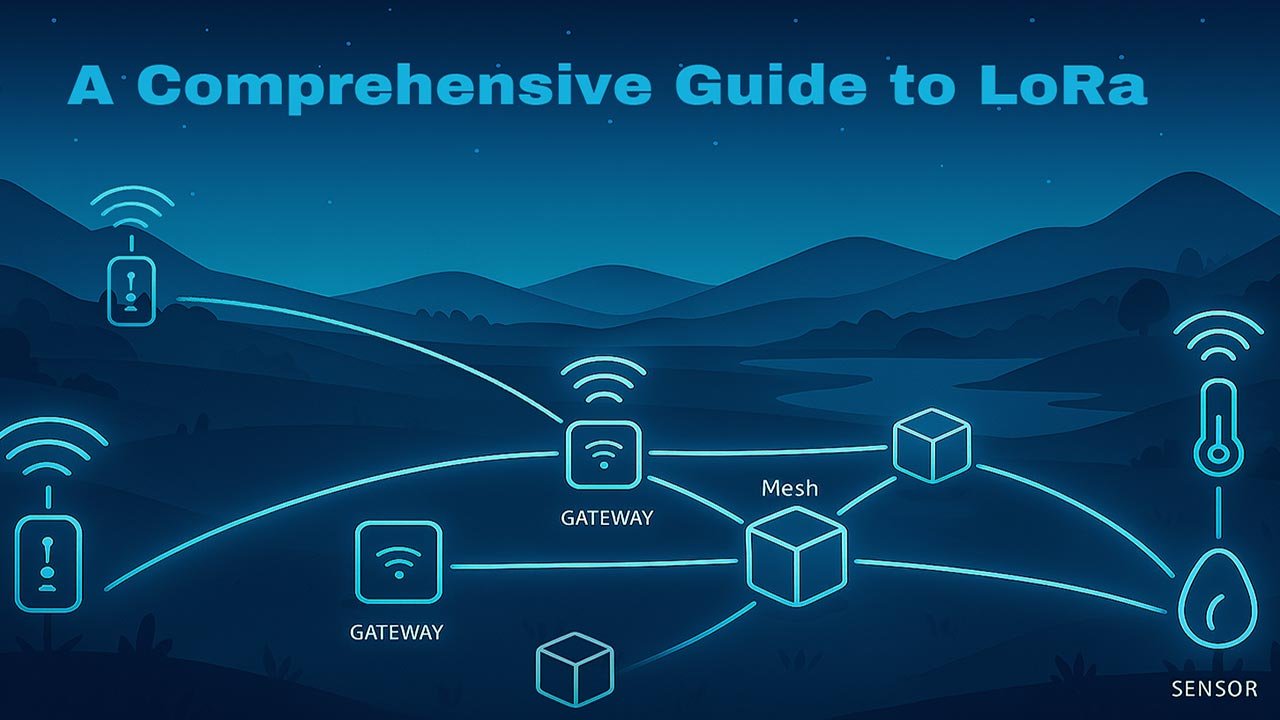
A Comprehensive Guide to LoRa
Below is a deep-dive exploration into LoRa technology—how it works, where it thrives, the ecosystem that sustains it, and why it has accelerated into one of the most influential wireless frameworks in modern innovation. This guide brings together technical clarity, industry relevance, and actionable insight.
Table of Contents
- Understanding LoRa: The Technology Behind the Trend
- How LoRa Works: Core Mechanics and Architecture
- Common Uses and Real-World Application Sectors
- Meshtastic: A Community-Driven Mesh Network Revolution
- LoRa Hardware Options: Modules, Gateways, and DIY Boards
- LoRa Software Ecosystem: Tools, Networks, and Platforms
- Open-Source Foundations Behind LoRa
- Governing Laws, Regulations, and Global Spectrum Rules
- Top 5 Frequently Asked Questions
- Final Thoughts
- Resources
Understanding LoRa: The Technology Behind the Trend
LoRa—short for “Long Range”—represents a breakthrough in low-power wireless communication. Originally developed by Semtech, LoRa’s unique modulation technology enables ultra-long-distance connectivity using minimal energy. That single advantage has made LoRa a cornerstone of the modern Internet of Things (IoT) landscape.
Instead of competing with high-bandwidth wireless protocols, LoRa optimizes for low data rates, minimal power consumption, and high receiver sensitivity. It is not the technology to stream video or transfer heavy files; it is the technology that sends a moisture reading from a vineyard sensor miles away or delivers environmental alerts from devices that run for years on coin-cell batteries.
LoRa splits into two major elements:
- LoRa the physical layer (PHY) — a proprietary chirp spread spectrum modulation
- LoRaWAN the MAC/network layer — an open networking protocol governed by the LoRa Alliance
The subtlety here matters because LoRa can be used with or without LoRaWAN, depending on user needs. Systems like Meshtastic use LoRa without LoRaWAN, taking advantage of LoRa’s raw radio layer while building their own networking stack.
This dual identity—proprietary PHY and open-spec networking—has supported an ecosystem where both commercial telecom-grade systems and grassroots DIY communities thrive.
How LoRa Works: Core Mechanics and Architecture
LoRa’s capabilities come from a set of technical decisions optimized for unique wireless characteristics. Below is a breakdown of the core mechanics in digestible form.
Chirp Spread Spectrum (CSS)
LoRa relies on chirp signals that sweep across a frequency range. These chirps are highly resilient to noise, enabling long-range signal survivability even in crowded RF environments. CSS has a history in military and radar use, but Semtech adapted it for ultra-low-power IoT.
Key Parameters
- Spreading Factor (SF)
Higher SF means longer range but slower data rates. Typical values range from SF7 to SF12. - Bandwidth (BW)
LoRa commonly uses bandwidths of 125 kHz, 250 kHz, or 500 kHz. A narrower bandwidth increases sensitivity and range. - Coding Rate (CR)
LoRa’s forward error correction improves reliability at the cost of airtime.
LoRaWAN Architecture Overview
LoRaWAN sits on top of LoRa PHY and defines the network behavior. Its architecture includes:
- End devices (sensors, trackers, environmental monitors)
- Gateways that forward packets between devices and network servers
- Network servers that manage routing, security, and MAC-layer logic
- Application servers that integrate data into platforms or dashboards
The system functions as a star-topology network, not a mesh.
Power Efficiency
A hallmark feature of LoRa is the ability for devices to sleep most of the time and wake only to transmit short bursts. Combined with optimized duty cycles, devices can last 5–10 years on small batteries.
Range
- Typical ranges (real-world):
- Urban: 2–5 km
- Suburban: 5–15 km
- Rural/open: 15–40 km
- Ideal line-of-sight: 100+ km achievable
Such distances are impossible for Wi-Fi, Bluetooth, and even traditional ISM-band radios operating at comparable power levels.
Common Uses and Real-World Application Sectors
Because LoRa is optimized for low power, long range, and small data payloads, it is ideal for scenarios where battery life and reach are more important than bandwidth.
Agriculture
LoRa sensors monitor:
- Soil moisture and temperature
- Water usage
- Crop health
- Livestock tracking
- Environmental conditions
Its ability to span entire farms without cellular towers makes LoRa extremely cost-effective.
Smart Cities
Municipalities deploy LoRa for:
- Smart parking systems
- Streetlight control
- Waste bin monitoring
- Air quality sensors
- Energy grid analytics
Cities adopt LoRaWAN because it provides mass scalability and low operating costs.
Industrial IoT
Industries use LoRa for:
- Predictive maintenance
- Safety monitoring
- Asset tracking across large facilities
- Pipeline and tank monitoring
The reliability of CSS modulation helps in RF-noisy industrial environments.
Consumer & Recreational Use
Outside of enterprise, LoRa is used for:
- Personal trackers
- Emergency beacon systems
- Outdoor group communication systems (Meshtastic)
- GPS-enabled adventure gear
LoRa’s DIY friendliness has generated a massive community of enthusiasts who build low-power communication networks in remote regions.
Environmental & Scientific Monitoring
LoRa supports countless sensor-driven research applications:
- Wildlife tracking
- Remote weather stations
- Glacier or volcano monitoring
- Ocean buoys using ultra-low-power RF
It has become a backbone for environmental data networks worldwide.
Meshtastic: A Community-Driven Mesh Network Revolution
Meshtastic is one of the most innovative LoRa-based projects in the world. Unlike LoRaWAN’s star topology, Meshtastic builds a true decentralized mesh network where each device can forward messages.
Key Attributes of Meshtastic
- Open-source
Entirely community-developed with transparent GitHub repositories. - Device-to-device communication
No gateway or infrastructure required. - Low-cost hardware compatibility
Works with inexpensive ESP32-based LoRa boards from multiple vendors. - Long-distance messaging
Devices can send texts, GPS coordinates, and sensor readings across miles. - Highly flexible encryption and privacy control
Supports secure messaging and channel configurations. - Growing global adoption
Meshtastic groups build mesh networks for hiking, off-grid communication, disaster preparedness, adventure sports, and community resilience.
Why Meshtastic Matters
Meshtastic demonstrates what is possible when LoRa is used outside the formal LoRaWAN structure. It proves that peer-to-peer mesh networking can be implemented effectively on low-power radios, empowering grassroots communication networks without telecom infrastructure.
LoRa Hardware Options: Modules, Gateways, and DIY Boards
The LoRa hardware ecosystem includes commercial-grade gateways, experimenter-friendly development boards, and integrated sensor platforms.
Popular LoRa Modules
These modules implement Semtech chipsets like the SX1276, SX1262, or LR1110.
- HopeRF RFM95/96/98 – Widely used in maker communities
- Semtech SX127x series – Industry standard for classic LoRa
- Semtech SX126x series – More efficient successor
- Ebyte LoRa modules – Low-cost and widely available
These modules are easy for embedded engineers to integrate into custom electronics.
Development Boards
Common boards for hobbyists and prototyping include:
- Heltec WiFi LoRa 32 – ESP32-based with OLED display
- TTGO T-Beam – Popular for Meshtastic; includes GPS
- Adafruit Feather LoRa – Well-documented and robust
- SparkFun LoRa boards – Professional-grade maker hardware
- RAKwireless WisBlock – Modular approach for production-grade IoT
These platforms provide quick paths from prototype to deployment.
LoRaWAN Gateways
Gateways vary from inexpensive single-channel units to professional multi-channel systems.
- Consumer/DIY Gateways
- Dragino LPS8
- TTN Indoor Gateway
- RAKwireless RAK7268
- Industrial Gateways
- Kerlink Wirnet series
- Multitech Conduit
- Laird Sentrius
Professional gateways support multiple channels, robust backhaul, higher sensitivity, and outdoor enclosures.
Integrated LoRa Devices
Many sensors come pre-packaged for plug-and-play deployment:
- Soil moisture probes
- Water meters with LoRaWAN transmitters
- GPS wildlife collars
- Environmental sensing nodes
These ready-to-deploy options accelerate large-scale IoT projects.
LoRa Software Ecosystem: Tools, Networks, and Platforms
LoRa’s flexibility supports a vast software ecosystem spanning network servers, device firmware, dashboards, and cloud platforms.
LoRaWAN Network Servers
Open-source options:
- The Things Stack (TTN/TTS) – Most widely used; highly community-driven
- ChirpStack – Industrial-grade open-source LoRaWAN server suite
- Proprietary platforms:
- LORIOT
- Actility ThingPark
- Senet
These systems handle device authentication, MAC-layer operations, uplink/downlink routing, and integration with cloud applications.
Embedded Firmware Libraries
To program LoRa devices, developers often use:
- Arduino LoRa library
- LMIC (LoRaWAN-MAC-in-C)
- RadioLib (versatile RF library supporting many chipsets)
- ESP-IDF LoRa libraries for ESP32
- Meshtastic firmware (LoRa mesh networking stack)
These tools simplify radio configuration and data transmission.
Cloud & Visualization Platforms
LoRa data often flows into visualization or analytics tools, such as:
- Node-RED
- Grafana
- InfluxDB
- AWS IoT Core
- Azure IoT Hub
- Ubidots
- ThingsBoard
These platforms transform raw sensor transmissions into actionable insights.
Open-Source Foundations Behind LoRa
While LoRa’s PHY layer is proprietary to Semtech, much of the surrounding ecosystem is deeply rooted in open-source development.
The LoRa Alliance
LoRaWAN, the network layer, is maintained by the LoRa Alliance—a global nonprofit association promoting interoperability and evolving the open specification. Membership includes hundreds of companies across telecommunications, sensor manufacturers, and enterprise IoT providers.
Open-Source Stack Examples
- ChirpStack – Fully open-source LoRaWAN network server
- The Things Network – Community-operated global LoRaWAN network
- Meshtastic – Peer-to-peer LoRa mesh firmware
- T-Beam and Heltec firmware – Open codebases for device control
Open-source innovation keeps LoRa accessible and adaptable, making it one of the most democratic communication technologies available today.
Community Collaboration
Developers worldwide contribute to:
- RF configuration optimizations
- Firmware improvements
- Custom networking stacks
- Mesh routing logic
- Security enhancements
This collaborative foundation fuels rapid innovation, especially outside of traditional telecom structures.
Governing Laws, Regulations, and Global Spectrum Rules
LoRa operates in unlicensed ISM (Industrial, Scientific, and Medical) bands, but rules vary by region.
Global Frequency Allocations
Common LoRa frequencies include:
- EU: 433 MHz, 868 MHz
- US: 915 MHz
- Asia: 433 MHz, 920–925 MHz
- Australia: 915–928 MHz
- India: 865–867 MHz
Each region enforces its own power limits, duty cycle restrictions, and channel guidelines.
Unlicensed, But Regulated
Even though LoRa uses unlicensed bands, users must comply with:
- Maximum transmit power
- Duty cycle limits
- Regional channel plans
- Fair-use regulations
Noncompliance can cause interference and may violate local law.
LoRaWAN Security Laws and Standards
The LoRa Alliance enforces strong encryption requirements:
- Unique keys per device
- AES-128 encryption
- Mutual authentication
While not government laws, these rules act as industry-mandated security standards.
Lack of Regulation in DIY Mesh Systems
Peer-based systems like Meshtastic operate without centralized oversight. This is legal so long as transmissions respect ISM-band regulations, but nations with stricter RF laws may require licensing for higher power transmissions or certain frequencies.
Global regulation is evolving, especially as low-power wireless systems expand into critical infrastructure.
Top 5 Frequently Asked Questions
Final Thoughts
The most important takeaway from this article is that LoRa represents a paradigm shift in how we build wireless systems. Rather than competing in the high-bandwidth race, LoRa thrives in the long-tail scenarios where power efficiency, extreme reach, and simplicity matter most. It has democratized wireless communication—empowering communities, advancing science, and enabling enterprises to deploy massive-scale, low-cost IoT networks. From LoRaWAN’s standardized global network architecture to Meshtastic’s decentralized human-to-human mesh, LoRa continues to fuel innovation across both professional and grassroots ecosystems. For innovators, engineers, hobbyists, and policymakers, understanding LoRa is essential to navigating the future of connected technology.
Leave A Comment