


Newly Released ESPConnect: Is This a Super Tool?
Todays article explores whether the newly released ESPConnect framework deserves the title of a “super tool.” We look at its capabilities, architecture, workflow efficiencies, use cases, limitations, and innovation potential, with a special focus on how it integrates with modern ESP32 development.
ESPConnect Web Interface: https://thelastoutpostworkshop.github.io/microcontroller_devkit/espconnect/
ESPConnect GitHub Repository: https://github.com/thelastoutpostworkshop/ESPConnect
Table of Contents
- What Is ESPConnect?
- Why ESPConnect Matters in Innovation & Technology Management
- Architecture and Core Technology
- Key Features That Make ESPConnect Stand Out
- Developer Workflow: How ESPConnect Changes the Game
- Deployment, Provisioning, and User Experience
- ESPConnect on GitHub: Repository Breakdown
- ESPConnect Web Interface: How It Works
- Competitive Analysis: Is It Truly a Super Tool?
- High-Value Use Cases
- Current Limitations and Challenges
- Future Outlook and Opportunities for Expansion
- Top 5 Frequently Asked Questions
- Final Thoughts
- Resources
What Is ESPConnect?
ESPConnect is an open-source communication and provisioning framework created by The Last Outpost Workshop. It is designed for ESP32-based microcontrollers and acts as a powerful connector layer that streamlines device setup, configuration, communication, and development iteration.
Its two main components:
- ESPConnect Firmware — the C++/Arduino codebase stored in the GitHub repo.
- ESPConnect Web Interface — a browser-based UI for real-time device communication.
ESPConnect simplifies complex workflows such as:
- Wi-Fi provisioning
- Real-time messaging
- Device state monitoring
- On-device configuration
- Local web-based interaction
For makers, developers, IoT engineers, and innovation managers, ESPConnect bridges the gap between prototype and product.
Why ESPConnect Matters in Innovation & Technology Management
Innovation and technology management revolves around accelerating development cycles, reducing risk, and getting functional prototypes running fast enough for real-world validation. ESPConnect directly contributes to these innovation goals by:
- Reducing onboarding friction — Easy provisioning saves hours of repetitive setup.
- Shortening feedback loops — Developers receive immediate real-time device feedback.
- Supporting scalable experimentation — Great for labs, classrooms, and rapid prototyping.
- Creating transparent communication pathways — Helps non-technical stakeholders see device behavior through the Web UI.
In innovation management frameworks (Lean Startup, Stage-Gate, Agile R&D), ESPConnect supports:
- Rapid prototyping
- Early-stage testing
- Iterative design cycles
- Cross-functional collaboration
This positions ESPConnect not as a simple connectivity tool but as an enabler of structured technology innovation.
Architecture and Core Technology
ESPConnect is built on a lightweight but powerful stack:
- C++/Arduino Framework — High compatibility with ESP32 boards.
- Async Web Server Architecture — Ensures responsive real-time communication.
- JSON message-based protocol — Enables structured, low-overhead communication.
- Bidirectional Messaging Between Browser and MCU — Using WebSockets.
- Local Hosting — No dependency on cloud services.
Key architectural advantage:
Low latency + stateless communication = extreme responsiveness.
This makes ESPConnect ideal for applications like robotics, motor control, environmental sensing, and interactive IoT systems.
Key Features That Make ESPConnect Stand Out
ESPConnect introduces several capabilities that reduce complexity while increasing developer control:
1. Real-Time Bidirectional Messaging
Messages between the web interface and ESP32 are exchanged instantly using WebSockets. This enables:
- Live sensor streaming
- Instant command execution
- UI-driven device configuration
- Remote state monitoring
2. Zero-Install Web Interface
The Web UI runs entirely in a browser. No Python scripts, no apps, no platform-specific limitations.
3. Persistent Configuration Management
ESPConnect stores and retrieves configuration parameters reliably. Developers can create devices that remember user settings without writing additional boilerplate code.
4. Robust Auto-Discovery & Local Access
ESPConnect supports identifying devices without complicated networking steps.
5. Modular Extensibility
The repository is structured so developers can quickly extend:
- command types
- supported UI elements
- custom device behaviors
This makes it a flexible technology base for future expansion.
Developer Workflow: How ESPConnect Changes the Game
A typical ESP32 workflow involves:
- Serial debugging
- Manual configuration
- Console logging
- Static UI building
ESPConnect replaces that with:
- Web-based monitoring
- Instant messaging
- No-code UI interaction
- Live telemetry views
By moving communication into the browser, ESPConnect modernizes ESP32 development.
Deployment, Provisioning, and User Experience
Provisioning is normally a headache in IoT development. ESPConnect removes friction by enabling:
- Local AP mode
- Simple Wi-Fi onboarding
- Consistent messaging protocol
Non-technical users can easily configure devices, which dramatically increases adoption potential.
ESPConnect on GitHub: Repository Breakdown
Repository URL: https://github.com/thelastoutpostworkshop/ESPConnect
The repo includes:
- Source code — Arduino/C++ implementation
- Example sketches — Quick start templates
- Documentation — Developer onboarding instructions
- JSON message structure — Protocol definitions
- WebSocket handlers
- Persistent settings utilities
The repository is actively maintained and structured clearly enough for beginners while remaining powerful for experts.
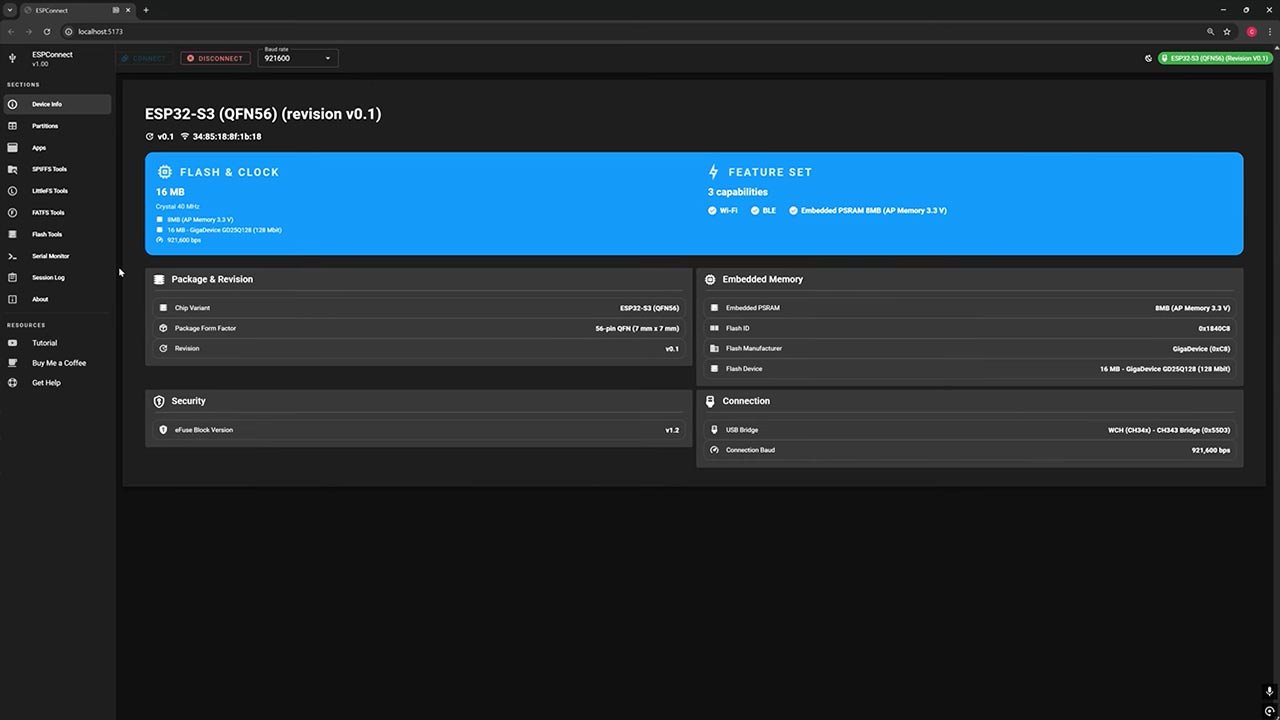
ESPConnect Web Interface: How It Works
Web Interface URL:
https://thelastoutpostworkshop.github.io/microcontroller_devkit/espconnect/
The Web UI provides:
- Live device data panels
- Command-sending interface
- Configuration menus
- System monitoring tools
It operates entirely in the browser and communicates with ESP32 locally via WebSockets. No cloud. No accounts. No setup.
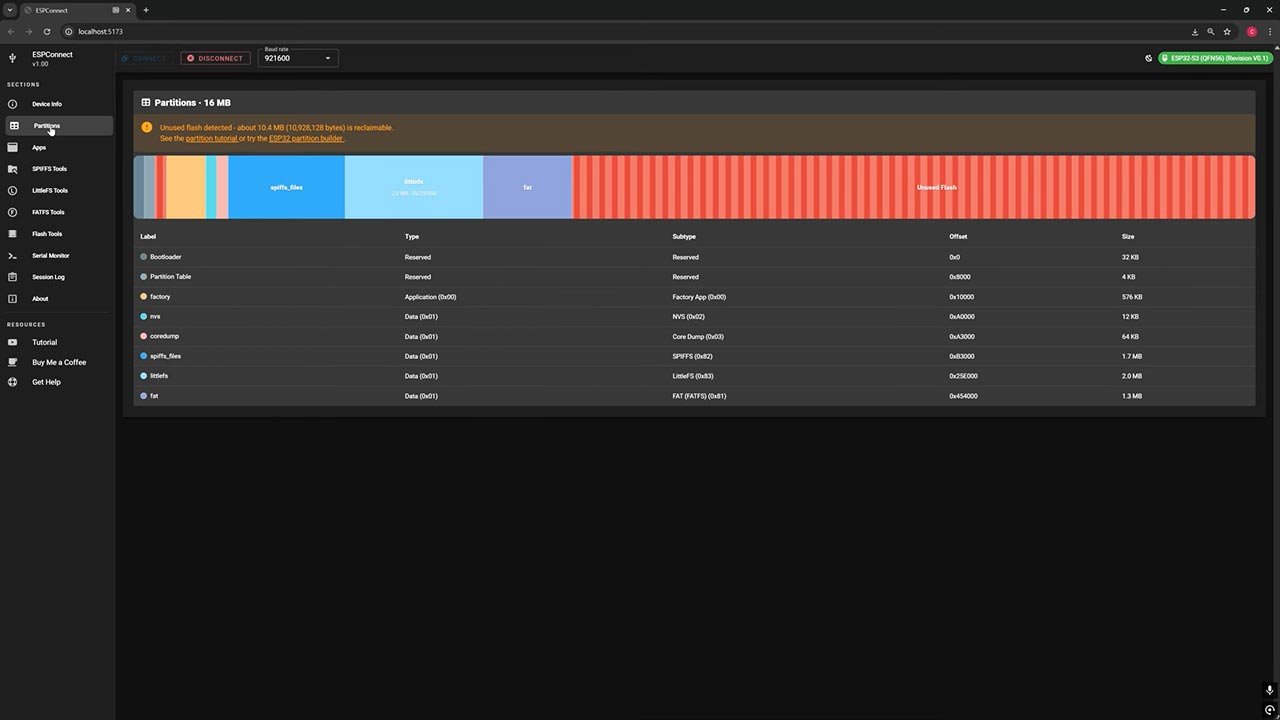
Partitions
Competitive Analysis: Is ESPConnect Truly a Super Tool?
To evaluate, we compare ESPConnect against:
- ESP RainMaker
- ESP-IDF Web Provisioning
- Arduino IoT Cloud
- Blynk
- Custom WebSocket implementations
Where ESPConnect dominates:
- Zero cloud dependency
- Simplified real-time messaging
- Browser-based UI
- Developer-focused functionality
- Lightweight footprint
Where alternatives still matter:
- No built-in cloud backend (if needed)
- Smaller ecosystem compared to enterprise platforms
Yet, for local-first IoT development, ESPConnect ranks among the most flexible, developer-friendly solutions available.
High-Value Use Cases
- Robotics
- Interactive IoT dashboards
- Home automation devices
- Educational electronics
- Rapid prototyping for startups
- Sensor-rich monitoring systems
- Device configuration utilities
By enabling real-time responsiveness with minimal overhead, it supports a broad range of technical applications.
Current Limitations and Challenges
- No integrated cloud support
- Requires basic Arduino/ESP32 knowledge
- UI customization requires manual editing
- Scaling to enterprise fleets requires additional infrastructure
These limitations do not diminish its value but help shape realistic expectations.
Future Outlook and Opportunities for Expansion
ESPConnect could grow significantly through:
- Cloud-optional features
- Dashboard customization tools
- Device discovery protocols
- Multi-device management panels
- Integrated firmware update flows
Given its simplicity and modularity, the framework has strong potential to influence future ESP32 development norms.
Top 5 Frequently Asked Questions
Final Thoughts
ESPConnect stands out as a genuinely transformative tool for ESP32 development. By combining real-time communication, a zero-install UI, persistent configuration support, and a clean messaging protocol, it streamlines innovation from prototype to product. Its architecture lowers friction for experimentation, accelerates feedback loops, and makes hardware behavior transparent to both developers and stakeholders.
While not a cloud ecosystem and not intended to replace enterprise-level platforms, ESPConnect excels where it matters most: enabling fast, flexible, local-first IoT development. Its thoughtful design, clear documentation, and browser-based workflow justify calling it — in many contexts — a “super tool” for rapid hardware innovation.


Leave A Comment