


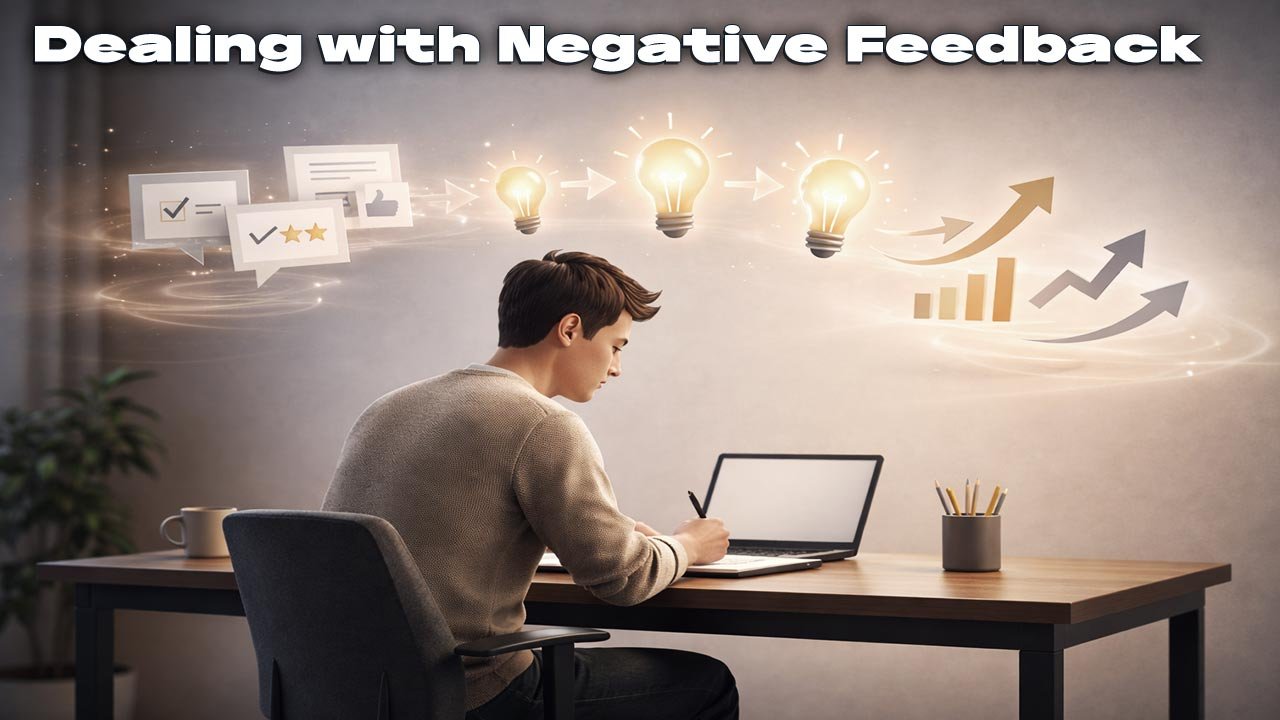
Dealing With Negative Feedback Without Losing Confidence
Creative work is deeply personal. Whether you are a designer, writer, filmmaker, musician, or product innovator, your output reflects your thinking, taste, and identity. Negative feedback can feel like a direct attack rather than a professional input. Yet research across creative industries consistently shows that the ability to process criticism constructively is one of the strongest predictors of long-term creative success.
Table of Contents
- Why Negative Feedback Hits Creatives So Hard
- Separate Your Identity From Your Work
- Learn to Filter Useful Criticism From Noise
- Create a Systematic Feedback Process
- Protect Psychological Safety and Confidence
- Turn Feedback Into Creative Growth
- Top 5 Frequently Asked Questions
- Final Thoughts
- Resources
Why Negative Feedback Hits Creatives So Hard
Creative work activates the same neurological pathways as personal expression. Studies in cognitive psychology show that creators often experience “identity fusion,” where personal worth becomes tightly coupled with creative output. When feedback is negative, the brain interprets it as social rejection rather than technical input. This explains why creatives often respond defensively, emotionally, or avoid feedback altogether. In innovation management research, teams that avoid criticism produce fewer breakthrough ideas. Google’s Project Aristotle found that psychological safety, not avoidance of critique, was the strongest factor in high-performing creative teams. The challenge is not eliminating negative feedback, but learning how to metabolize it productively.
Separate Your Identity From Your Work
One of the most important skills a creative can develop is detachment. Your work is something you made, not who you are. High-performing creatives mentally reframe feedback as information about the artifact, not a judgment of their value or talent. A useful technique borrowed from design thinking is objectification. Label the work as “the draft,” “the concept,” or “the prototype.” This subtle linguistic shift creates emotional distance and reduces defensive reactions. Pixar famously enforces this mindset during “Braintrust” sessions, where ideas are critiqued aggressively while creators are protected.
Learn to Filter Useful Criticism From Noise
Not all feedback deserves equal weight. Experienced creatives develop strong filtering mechanisms. Ask three questions before acting on criticism:
- Is the feedback coming from someone who understands the goal, audience, or constraints of the work
- Is the feedback specific and actionable rather than vague or emotional
- Does the feedback reveal a pattern echoed by others
Harvard Business School research shows that repeated feedback from diverse but informed sources is significantly more predictive of improvement than isolated opinions. Social media comments, anonymous reviews, and uninformed critiques often reflect taste rather than truth.
Create a Systematic Feedback Process
Creatives who suffer most from negative feedback often encounter it randomly and without context. A structured feedback process transforms criticism into a manageable workflow. This includes setting clear review stages, defining feedback criteria, and separating exploratory critique from final evaluation. In product innovation teams, structured critique cycles reduce emotional burnout by up to 30 percent while increasing iteration speed. When feedback becomes expected and time-bound, it loses its sting and gains utility.
Protect Psychological Safety and Confidence
Confidence is not the absence of criticism, but the belief that you can handle it. Creatives must actively protect their psychological safety by choosing when, where, and from whom they receive feedback. This does not mean avoiding critique, but curating it. Neuroscience research shows that constant exposure to negative evaluation without recovery time increases cortisol levels and reduces creative risk-taking. Elite creatives balance critique with recovery, reflection, and periods of unfiltered creation.
Turn Feedback Into Creative Growth
A growth mindset reframes negative feedback as a data signal. Instead of asking “Do they like it?” high-performing creatives ask “What is this telling me about clarity, resonance, or execution?” Over time, this reframing compounds into creative resilience. In longitudinal studies of writers, designers, and engineers, those who actively documented feedback patterns improved skill acquisition nearly twice as fast as peers who relied on intuition alone. Feedback, when tracked and analyzed, becomes a strategic advantage.
Top 5 Frequently Asked Questions
Final Thoughts
Negative feedback is unavoidable in creative work, but suffering from it is optional. The most successful creatives are not those who receive less criticism, but those who build systems, mindsets, and boundaries that transform critique into leverage. By separating identity from output, filtering feedback intelligently, and maintaining psychological safety, creatives turn discomfort into mastery. Feedback is not the enemy of creativity. Mismanaged feedback is.
Resources
- Harvard Business School – Research on Feedback and Performance
- Google re:Work – Project Aristotle
- Carol Dweck – Mindset Research
- IDEO – Design Thinking and Feedback Loops
- Pixar – Creativity, Inc.







Leave A Comment