


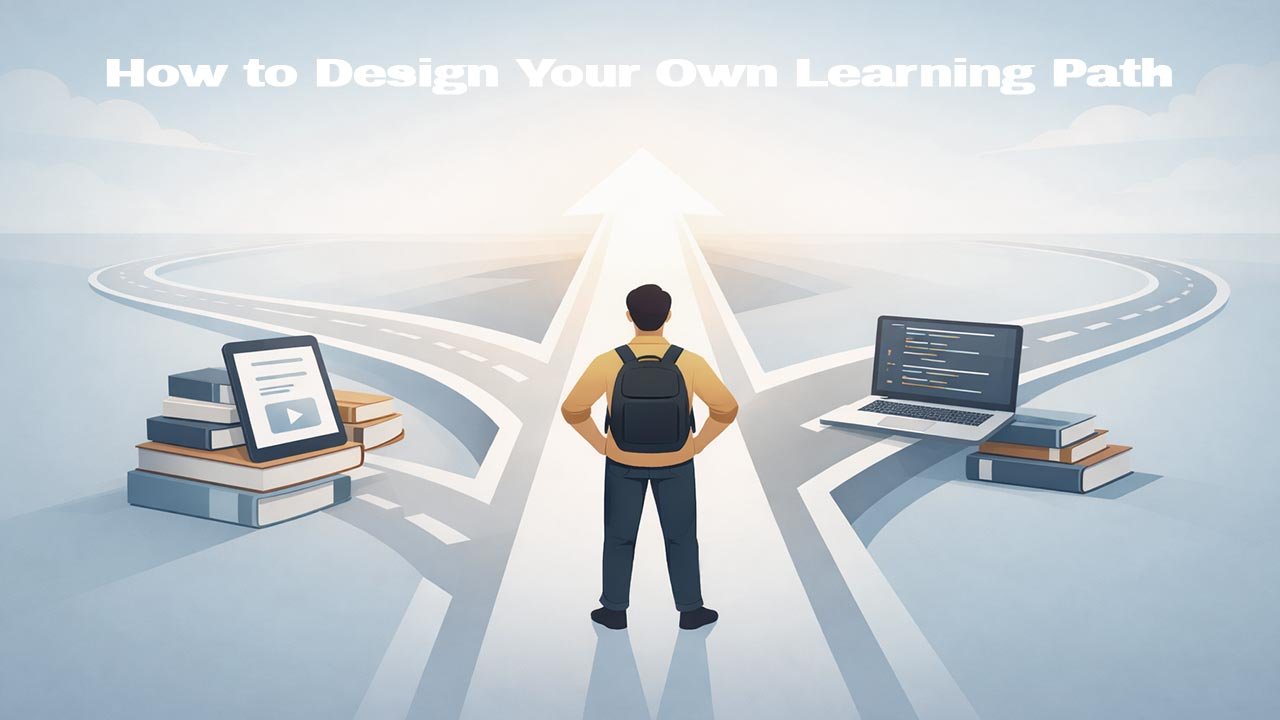
How to Design Your Own Learning Path (Without Getting Overwhelmed)
Learning no longer belongs to classrooms, degrees, or rigid curricula. In a world where skills evolve fast, designing your own learning path is a practical advantage—and often a career necessity. This guide gives you a clear, low-stress way to choose what to learn, in what order, how to practice it, and how to stay consistent without burning out.
Table of Contents
- Why Self-Directed Learning Matters More Than Ever
- Common Mistakes That Cause Learning Overwhelm
- Define a Clear Learning Goal Before You Start
- Map Skills Backwards From Outcomes
- How to Choose the Right Learning Resources
- Design Learning Sprints Instead of Long Plans
- Build Feedback Loops Into Your Learning
- How to Avoid Burnout While Learning Independently
- Track Progress Without Killing Motivation
- Turn Your Learning Path Into a Long-Term System
- Top 5 Frequently Asked Questions
- Final Thoughts
- Resources
Why Self-Directed Learning Matters More Than Ever
The biggest shift in modern work is not remote work, AI tools, or globalization. It is velocity. Roles change faster than traditional training systems can update. That means your advantage comes from how quickly you can learn and apply new capabilities.
Organizations are hiring for adaptable, “learnable” talent because they cannot rely on static job descriptions anymore. In innovation and technology management, this is especially obvious. Tools change. Processes evolve. Entire product categories appear and disappear within a decade. The difference between someone who stays relevant and someone who stalls is rarely intelligence—it is learning strategy.
Self-directed learning gives you three strategic advantages:
- Speed: you can learn what your role needs now, not what a curriculum planned years ago
- Fit: you tailor depth and focus to your exact context, industry, and ambition
- Compounding: consistent learning builds a flywheel, where each skill makes future skills easier
But self-directed learning has a downside: choice overload. Without structure, people accumulate bookmarks, buy courses, and start too many tracks at once—then quit because the system feels heavy. The goal is not to learn everything. The goal is to build a learning path that is narrow enough to execute and flexible enough to adapt.
Common Mistakes That Cause Learning Overwhelm
Trying to Learn Everything at Once
Overwhelm usually starts with an unclear scope. “Learn data analytics,” “get into product management,” or “understand AI” are not learning goals—they are entire ecosystems. Each one includes foundational knowledge, tools, workflows, and domain judgment. When your brain sees infinite scope, it delays action because it cannot predict what “done” looks like.
A better approach is to narrow learning into a deliverable: a dashboard, a product case study, a working prototype, a portfolio project, a certification exam, a stakeholder presentation, or a measurable business outcome.
Confusing Consumption With Progress
Modern learning platforms are designed to keep you watching. That is useful for engagement, but it is a trap for skill building. Consumption is input. Skill is output.
If your learning path does not force output—writing, building, testing, presenting, shipping—then you are not building competency. You are building familiarity. Familiarity feels good and looks productive, but it collapses under real-world pressure.
Overplanning Before Starting
Many people try to solve uncertainty by planning harder. They map a 12-month curriculum, build spreadsheets, compare 15 courses, and postpone starting until they feel sure. The problem is that learning is an adaptive process. You cannot plan what you do not yet understand.
The right approach is to plan in short cycles, learn, adjust, then plan again. Planning should serve action, not replace it.
Define a Clear Learning Goal Before You Start
A well-defined learning goal is the foundation of a stress-free learning path. It reduces decisions, narrows resources, and makes progress visible.
The strongest goals are:
- Outcome-based: tied to something you can produce or demonstrate
- Time-bounded: has a deadline that creates momentum
- Context-specific: connected to your job, your target role, or your industry
Examples that work:
- Build a portfolio-ready UX case study with user testing results in 8 weeks
- Create a forecasting model in Excel and present results to a mock stakeholder audience in 6 weeks
- Ship a simple web app that uses an API and deploy it publicly in 30 days
- Prepare for a Scrum Master certification and pass in 10 weeks
When you define the outcome, your learning path becomes a project plan. And projects naturally create structure without feeling restrictive.
Map Skills Backwards From Outcomes
If your target outcome is a deliverable, then your job is to reverse-engineer the skill stack needed to create it.
Start With the End Deliverable
Ask:
- What does “good” look like for this outcome?
- What standards or examples can I use as a benchmark?
- What would a hiring manager, client, or stakeholder expect?
For example, if your outcome is a product case study, then “good” likely includes customer problem framing, success metrics, prioritization logic, tradeoffs, and clear communication. That reveals the skills you need to learn.
Break It Into Skill Layers
Most capabilities have three layers:
- Foundational knowledge: terms, concepts, mental models
- Applied techniques: the methods you actually use
- Contextual judgment: when to use what, and why
Overwhelm often happens when people jump to advanced contextual judgment before they have built the applied techniques. The reverse also happens: people get stuck learning endless foundations without practicing.
A balanced learning path deliberately moves from foundation → technique → judgment, with frequent output along the way.
How to Choose the Right Learning Resources
Resources are not your learning plan. Resources are inputs. Your plan is the sequence of outputs you will produce.
Limit Yourself to One Core Resource Per Skill
For each major skill area, pick one core resource to anchor your learning. This could be:
- a structured course with exercises
- a reputable textbook
- official documentation plus a guided tutorial series
More resources increase cognitive load. If you want depth later, you can expand—but start with one.
Evaluate Credibility and Relevance
Use fast filters:
- Was it updated recently?
- Does it include practice, not just explanation?
- Does it reflect current tools and real workflows?
- Is the instructor or author actively working in the field?
For innovation and technology management topics, prioritize resources that reflect real organizational constraints, not idealized theory.
Use Supplementary Content Strategically
Supplementary content is best for:
- clarifying a confusing concept
- seeing alternate explanations
- getting examples from different domains
- staying motivated through stories and case studies
It is not best for building skill on its own. If supplementary content becomes your primary activity, your learning path will feel busy but not effective.
Design Learning Sprints Instead of Long Plans
Your learning path should feel like a sequence of achievable missions, not a giant mountain.
What Is a Learning Sprint?
A learning sprint is a short cycle (typically 2–4 weeks) with:
- one primary skill focus
- one concrete deliverable
- one review point for feedback
Example sprint for “basic data analysis”:
- Week 1: clean a messy dataset
- Week 2: build 3 charts and interpret patterns
- Week 3: write insights and recommendations like a stakeholder memo
Why Sprints Reduce Overwhelm
Sprints reduce overwhelm because they:
- shrink the time horizon, which reduces anxiety
- create quick wins, which increases motivation
- help you iterate faster when you realize your plan needs change
This is exactly how innovative organizations manage uncertainty: small experiments, fast feedback, constant adjustment. Your learning path should operate the same way.
Build Feedback Loops Into Your Learning
Feedback is how you convert effort into improvement. Without it, you repeat the same errors and mistake time spent for progress.
Internal Feedback
Ways to create internal feedback:
- explain what you learned in writing, in plain language
- teach it to someone else, even informally
- rebuild a project from memory without notes
- compare your output to a benchmark example
The moment you struggle to explain something clearly is valuable data. It tells you what to revisit.
External Feedback
External feedback options:
- post your work in a professional community
- ask a peer to review your output
- find a mentor for monthly check-ins
- use rubric-based evaluation (especially for writing, design, and analysis)
In technology management, feedback from practitioners is particularly valuable because it reveals what is “technically correct” versus what is “organizationally useful.”
How to Avoid Burnout While Learning Independently
Most burnout is not from learning too much. It is from unclear expectations, unrealistic pace, and lack of recovery.
Separate Learning Time From Performance Time
Some sessions are for exploration and messy drafts. Others are for polishing and presenting. If you expect perfect output every time, learning becomes stressful and your brain avoids it.
A practical structure:
- 70% learning and building
- 20% review and improvement
- 10% final polish
Design for Sustainability
Sustainable learning is consistent learning. Use a pace you can maintain even during busy weeks.
Sustainability tactics:
- set a minimum daily “floor” (like 20 minutes)
- use themed days (practice days vs review days)
- avoid stacking multiple heavy skills simultaneously
- schedule recovery time like it is part of the plan
Your goal is not maximum effort. Your goal is long-term compounding.
Track Progress Without Killing Motivation
Tracking should reduce overwhelm, not add administrative work.
Track Outputs, Not Hours
Hours are unreliable because they measure time, not competence. Output-based tracking shows whether learning is translating into capability.
Outputs include:
- completed exercises
- mini projects
- drafts and revisions
- public posts explaining concepts
- portfolio pieces
Use Visible Proof of Progress
Keep a “proof trail”:
- a simple learning log
- a folder of versions
- a portfolio page
- a checklist of deliverables
Visible progress reduces the feeling that you are “still behind,” which is a common emotional trigger for overwhelm.
Turn Your Learning Path Into a Long-Term System
A learning path is a temporary structure. A learning system is a permanent advantage.
A strong learning system includes:
- Skill audits: monthly or quarterly reflection on gaps and strengths
- Learning sprints: short cycles tied to outcomes
- Practice loops: repeated application in real contexts
- Portfolio building: evidence that your learning is useful
For innovation and technology management, this system is especially powerful because your value comes from translating emerging tools into organizational outcomes. That requires constant scanning, experimenting, and learning.
Over time, you stop asking, “What should I learn?” and start asking, “What experiment should I run next?” That shift removes overwhelm because it converts learning into action.
Top 5 Frequently Asked Questions
Final Thoughts
A calm learning path is not one with fewer ambitions. It is one with clearer sequencing. Overwhelm usually means your system is asking your brain to do too many choices at once: what to learn, how to learn, what resources to trust, how to measure progress, and how to stay motivated.
When you design your learning path like an innovation process—small experiments, fast feedback, clear deliverables—you remove the chaos while keeping the freedom. You stop collecting knowledge and start building capability.
The most important takeaway is this: your learning path should be designed around outputs. Outputs create clarity, momentum, evidence, and confidence. And once you have that, learning stops feeling overwhelming and starts feeling inevitable.







Leave A Comment