


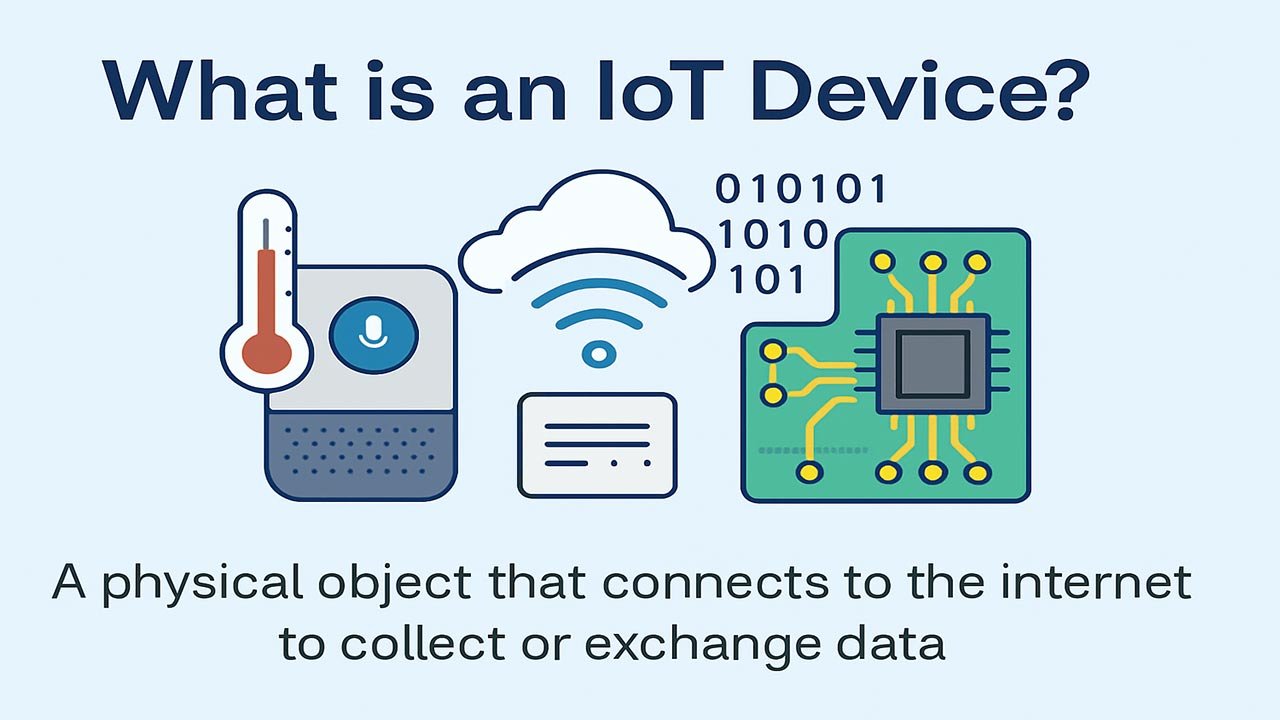
What is an IoT Device? A Guide to Connected Technology
An IoT device is a physical object embedded with sensors, software, and connectivity that enables it to collect, transmit, and act on data over the internet without requiring direct human interaction. These devices form the foundation of the Internet of Things, a global ecosystem that connects billions of everyday objects into intelligent, responsive networks.
From smart thermostats and wearable fitness trackers to industrial sensors and autonomous vehicles, IoT devices are redefining how technology interacts with the physical world. Their impact extends across homes, cities, healthcare systems, manufacturing plants, and global supply chains.
Table of Contents
- Defining an IoT Device
- How an IoT Device Works
- Core Components of an IoT Device
- Types of IoT Devices
- Real-World Examples of IoT Devices
- Key Benefits of IoT Devices
- Security and Privacy Risks
- Business and Industry Impact
- The Future of IoT Devices
- Top 5 Frequently Asked Questions
- Final Thoughts
- Resources
Defining an IoT Device
An IoT device is any non-traditional computing hardware capable of connecting to the internet and exchanging data. Unlike laptops or smartphones, IoT devices are purpose-built for specific functions such as monitoring temperature, tracking movement, or optimizing energy usage.
According to Gartner, more than 14 billion IoT devices are currently in use worldwide, with projections exceeding 25 billion by 2030. This explosive growth reflects a shift toward ambient computing, where intelligence is embedded directly into the environment rather than centralized in traditional computers.
How an IoT Device Works
IoT devices operate through a continuous data loop. Sensors collect data from the physical environment, such as humidity, motion, or heart rate. That data is transmitted via a network to a processing platform, often cloud-based, where it is analyzed.
Based on predefined rules or machine learning models, the system triggers an action. This action could be sending an alert, adjusting a mechanical component, or updating a dashboard in real time. The process occurs autonomously, often in milliseconds.
Core Components of an IoT Device
Every IoT device consists of several essential components working together.
Sensors and actuators allow the device to perceive and interact with its environment. Connectivity modules such as Wi-Fi, Bluetooth, cellular, or LPWAN enable data transmission. Embedded processors execute firmware instructions. Software platforms manage data storage, analytics, and visualization. Power sources, often batteries or energy-harvesting systems, sustain long-term operation.
The integration of these components determines the device’s reliability, scalability, and security.
Types of IoT Devices
IoT devices fall into several major categories based on use case.
Consumer IoT includes smart home devices like lighting systems, voice assistants, and appliances. Industrial IoT focuses on machinery monitoring, predictive maintenance, and automation. Healthcare IoT encompasses remote patient monitoring devices and connected medical equipment. Smart city IoT supports traffic management, waste collection, and environmental monitoring. Agricultural IoT improves irrigation efficiency and livestock tracking.
Each category prioritizes different performance metrics such as latency, battery life, or data accuracy.
Real-World Examples of IoT Devices
A smart thermostat learns user behavior and adjusts heating to reduce energy consumption. Wearable health devices track vital signs and share data with healthcare providers. Industrial sensors detect equipment anomalies before failures occur. Connected vehicles optimize navigation using real-time traffic data. Smart meters provide utilities with precise consumption insights.
These examples illustrate how IoT devices move technology from passive tools to active decision-makers.
Key Benefits of IoT Devices
IoT devices deliver measurable value through automation, efficiency, and insight.
They reduce operational costs by minimizing manual intervention. They improve decision-making through real-time analytics. They enhance safety by detecting risks early. They enable personalization by adapting to user behavior. For businesses, IoT devices unlock new revenue models such as usage-based services and predictive maintenance contracts.
McKinsey estimates that IoT could generate up to $12.6 trillion in economic value annually by 2030.
Security and Privacy Risks
Despite their advantages, IoT devices introduce significant risks. Limited processing power often restricts advanced security controls. Poorly secured devices can be exploited for data breaches, surveillance, or botnet attacks.
Privacy concerns arise when personal data is continuously collected without transparency. Effective IoT governance requires encryption, regular firmware updates, identity management, and compliance with data protection regulations such as GDPR.
Business and Industry Impact
IoT devices are a cornerstone of digital transformation strategies. They enable data-driven operations, real-time visibility, and adaptive systems. Industries such as manufacturing, logistics, healthcare, and energy increasingly rely on IoT to remain competitive.
From an innovation management perspective, IoT shifts value creation from products to platforms, emphasizing ecosystems, interoperability, and long-term data ownership.
The Future of IoT Devices
The next generation of IoT devices will integrate artificial intelligence, edge computing, and 5G connectivity. Devices will process data locally to reduce latency and improve privacy. Energy-efficient designs will extend lifespan. Standardization efforts will improve interoperability across ecosystems.
As IoT matures, devices will become invisible yet indispensable, embedded seamlessly into daily life and industrial infrastructure.
Top 5 Frequently Asked Questions
Final Thoughts
An IoT device represents a fundamental shift in how technology interacts with the physical world. By embedding intelligence into everyday objects, IoT transforms passive environments into responsive systems. The true power of IoT lies not in individual devices but in the data-driven ecosystems they create. Organizations that understand and manage this shift strategically will shape the future of connected innovation.
Resources
- Gartner IoT Forecast Reports
- McKinsey Global Institute: The Internet of Things
- IBM IoT Reference Architecture
- ISO/IEC IoT Standards Documentation

Leave A Comment