


Transistors for Beginners: Switching, Amplifying & Basic Logic
Transistors are one of the most important inventions in modern technology. Every smartphone, computer, car, and smart device relies on billions of them working together. Despite their importance, transistors often feel intimidating to beginners. This guide breaks them down into simple ideas so you can understand what they do, how they work, and why they matter.
Table of Contents
- What Is a Transistor?
- Why Transistors Matter in Electronics
- How Transistors Work
- Transistors as Switches
- Transistors as Amplifiers
- Basic Logic Using Transistors
- Common Types of Transistors
- Common Beginner Mistakes
- Real-World Applications
- Top 5 Frequently Asked Questions
- Final Thoughts
- Resources
What Is a Transistor?
A transistor is a semiconductor device that controls the flow of electricity. It acts like an electronically controlled valve, deciding when current flows and how much of it passes through. Unlike mechanical switches, transistors have no moving parts, which makes them extremely fast and reliable. At its core, a transistor has three terminals. One terminal controls the other two. By applying a small electrical signal to the control terminal, you can turn a much larger current on or off or regulate its strength.
Why Transistors Matter in Electronics
Before transistors, electronic devices relied on vacuum tubes. These were large, fragile, inefficient, and consumed massive amounts of power. Transistors replaced them and enabled electronics to become smaller, cheaper, faster, and more energy efficient. Modern microprocessors contain billions of transistors packed into a chip smaller than a fingernail. Without transistors, digital computing, mobile devices, and the internet would not exist. If you are new to circuits, reviewing basic electronics concepts can help, such as voltage, current, and resistance. A solid starting point is this internal guide to basic electronics.
How Transistors Work
Transistors are made from semiconductor materials, usually silicon. Semiconductors can behave like conductors or insulators depending on how they are treated. Inside a transistor, regions of silicon are modified to create areas with extra electrons or missing electrons. This structure allows a small input signal to control a much larger output signal. The key idea is control. A weak signal at the input determines the behavior of a stronger signal at the output.
Transistors as Switches
One of the simplest and most common uses of a transistor is as an electronic switch. In this mode, the transistor is either fully on or fully off. When the control terminal receives enough voltage or current, the transistor turns on and allows current to flow freely. When the control signal is removed, the transistor turns off and blocks current. This behavior is ideal for digital systems where signals are represented as ones and zeros. Every logic gate, memory cell, and digital processor relies on transistors operating as switches. The speed of switching can reach billions of times per second in modern chips.
Transistors as Amplifiers
Transistors can also amplify signals. In this mode, a small input signal causes a proportional but much larger output signal. For example, a weak audio signal from a microphone is far too small to drive a speaker. A transistor amplifier boosts that signal so it becomes powerful enough to move the speaker cone and produce sound. Amplification works because the transistor uses power from an external supply. The input signal controls how much of that power flows through the output. This principle is used in audio systems, radio transmitters, and sensor circuits.
Basic Logic Using Transistors
Digital logic is built by combining transistors in specific arrangements. A single transistor can act as a simple inverter, also known as a NOT gate. When the input is high, the output is low, and vice versa. By combining multiple transistors, engineers create AND, OR, NAND, and NOR gates. These gates form the building blocks of all digital systems. Even complex operations like video rendering and artificial intelligence reduce down to vast networks of transistor-based logic gates switching on and off.
Common Types of Transistors
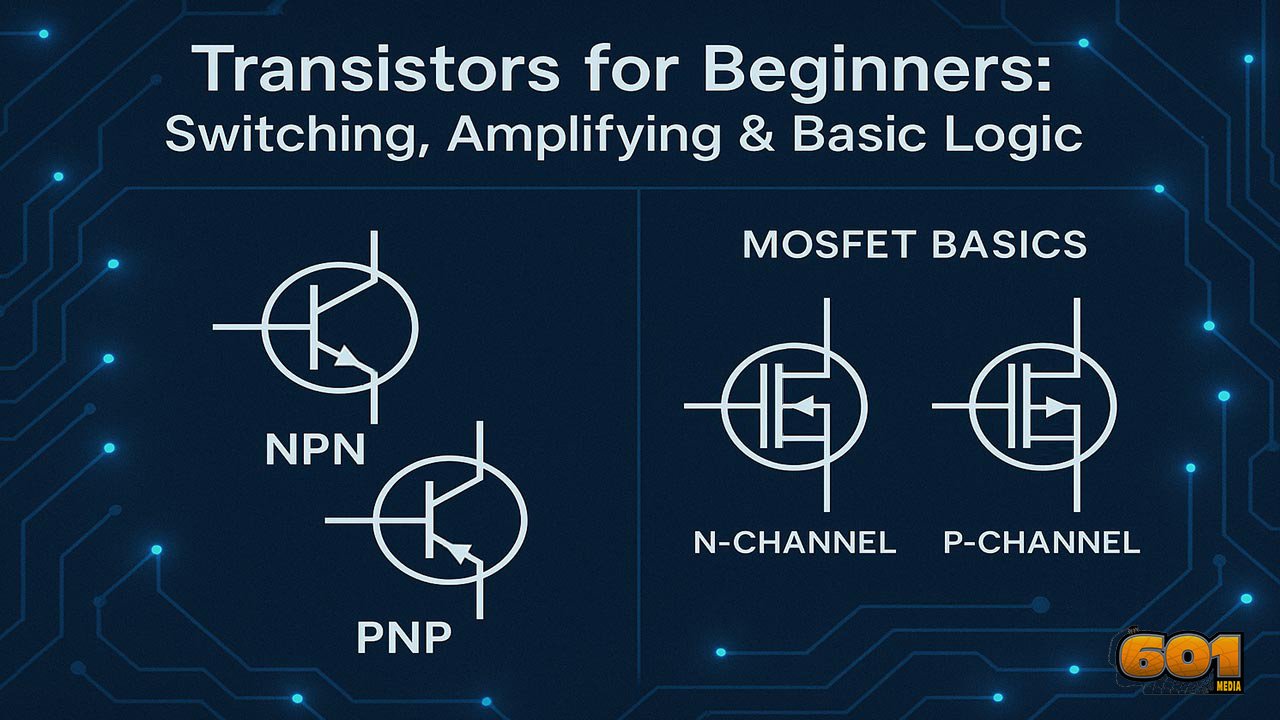
There are two main transistor families beginners should know. Bipolar Junction Transistors, or BJTs, use current to control current. They are commonly used in amplification circuits and educational projects. Metal-Oxide-Semiconductor Field-Effect Transistors, or MOSFETs, use voltage to control current. They dominate modern digital electronics because they are efficient and easy to scale down in size. Understanding both types gives beginners a strong foundation for further learning.
Common Beginner Mistakes
One common mistake is confusing transistor pin layouts. Different transistors have different terminal arrangements, and incorrect wiring can damage components. Another mistake is forgetting current-limiting resistors. Applying too much current can destroy a transistor instantly. Beginners should always calculate safe operating conditions before powering a circuit. Finally, many beginners expect transistors to behave like ideal switches. In reality, there are voltage drops, delays, and power losses that must be considered.
Real-World Applications
Transistors appear in nearly every electronic system. They control motors in appliances, amplify signals in communication systems, regulate voltage in power supplies, and form the brains of computers. As devices become smarter and more connected, the importance of transistors continues to grow. Learning how they work opens the door to understanding robotics, embedded systems, and digital design.
Top 5 Frequently Asked Questions
Final Thoughts
Transistors are the foundation of modern electronics because they allow small signals to control large amounts of power with speed and precision. Whether switching digital states, amplifying analog signals, or forming complex logic systems, transistors make today’s technology possible. For beginners, mastering transistor fundamentals is a major step toward confidently designing and understanding real electronic systems.
Resources
- Horowitz, P., & Hill, W. The Art of Electronics, Cambridge University Press
- Sedra, A., & Smith, K. Microelectronic Circuits, Oxford University Press
- All About Circuits – Transistor Fundamentals
Leave A Comment