


Introduction to Relays & Solid-State Switching
Relays and solid-state switching devices are foundational components in modern electrical and electronic systems. From industrial automation and power distribution to consumer electronics and automotive systems, these switching technologies enable safe, reliable, and efficient control of electrical loads. Understanding how they work, where they excel, and their limitations is essential for engineers, technicians, and technology managers navigating increasingly automated environments.
Table of Contents
- Understanding Relay Basics
- Types of Electromechanical Relays
- What Is Solid-State Switching?
- Solid-State Relays vs Electromechanical Relays
- Key Applications Across Industries
- How to Choose the Right Switching Technology
- Future Trends in Switching Technologies
- Top 5 Frequently Asked Questions
- Final Thoughts
- Resources
Understanding Relay Basics
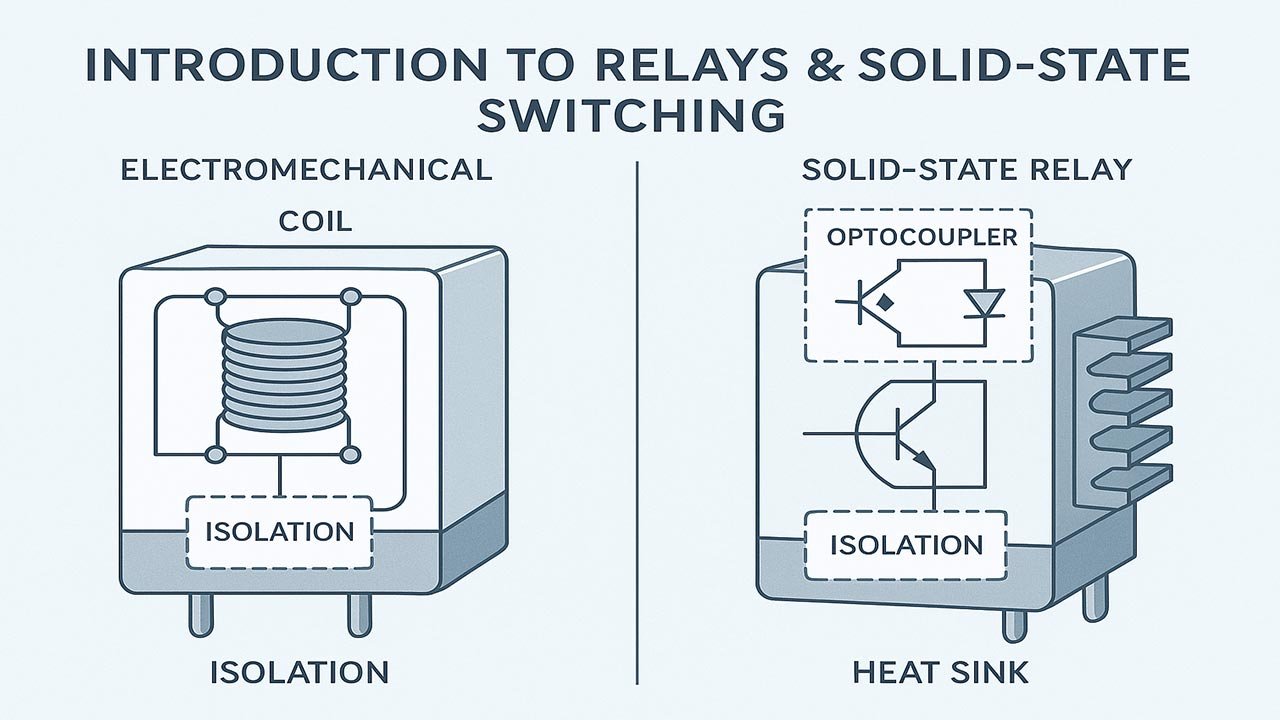
A relay is an electrically operated switch that uses an electromagnetic coil to mechanically open or close contacts. When voltage is applied to the coil, a magnetic field is generated, pulling a contact armature into position and completing or interrupting a circuit. This mechanism allows a low-power control signal to manage a higher-power load. Relays provide galvanic isolation between control and load circuits, improving safety and reducing the risk of equipment damage. This isolation is a major reason relays remain widely used in industrial control systems, power grids, and safety-critical environments. A solid starting point is this internal guide to basic electronics.
Types of Electromechanical Relays
Electromechanical relays come in several forms, each optimized for specific operational needs. General-purpose relays are commonly used in control panels and automation systems. Power relays are designed to handle higher currents and voltages, often found in motor control and HVAC equipment. Reed relays use sealed magnetic contacts, making them suitable for low-level signal switching and instrumentation. Latching relays maintain their state without continuous coil power, improving energy efficiency in battery-powered systems. Despite their versatility, all electromechanical relays share inherent limitations such as contact wear, mechanical noise, and slower switching speeds.
What Is Solid-State Switching?
Solid-state switching replaces mechanical contacts with semiconductor devices such as triacs, thyristors, MOSFETs, or IGBTs. A solid-state relay (SSR) performs the same functional role as a traditional relay but switches loads electronically instead of mechanically. Because there are no moving parts, solid-state switches offer silent operation, extremely fast response times, and virtually unlimited switching life. These characteristics make them ideal for high-speed automation, precision control, and environments subject to vibration or contamination.
Solid-State Relays vs Electromechanical Relays
Electromechanical relays excel in applications requiring true off-state isolation and low on-state resistance. They generate minimal heat when conducting and are tolerant of voltage spikes. Solid-state relays, on the other hand, switch in microseconds rather than milliseconds and are immune to mechanical wear. However, they introduce a small voltage drop across the output device, resulting in continuous power dissipation and heat generation. SSRs also require proper heat sinking and are more sensitive to overvoltage conditions. In practice, the choice between these technologies depends on switching speed, load type, environmental conditions, and lifecycle cost.
Key Applications Across Industries
In industrial automation, relays and SSRs control motors, solenoids, and heaters in programmable logic controller systems. The automotive sector uses them for power distribution, battery management, and safety systems. Consumer electronics rely on solid-state switching for silent operation and compact form factors. Power utilities and renewable energy systems increasingly favor solid-state solutions for fast fault isolation and smart grid applications, aligning with standards published by organizations such as the International Electrotechnical Commission.
How to Choose the Right Switching Technology
Selecting the correct switching solution requires evaluating electrical load characteristics, including voltage, current, and whether the load is resistive, inductive, or capacitive. Environmental factors such as temperature, vibration, and electromagnetic interference also play a role. Lifecycle considerations matter. While electromechanical relays typically have lower upfront costs, solid-state devices often provide lower total cost of ownership in high-cycle applications due to reduced maintenance and longer service life.
Future Trends in Switching Technologies
Advances in wide-bandgap semiconductors such as silicon carbide and gallium nitride are accelerating the adoption of solid-state switching. These materials enable higher switching frequencies, lower losses, and improved thermal performance. Hybrid relays, which combine mechanical contacts with solid-state elements, are also gaining traction. They leverage electronic switching to eliminate arcing while maintaining the low conduction losses of mechanical contacts, offering a compelling balance for next-generation power systems.
Top 5 Frequently Asked Questions
Final Thoughts
Relays and solid-state switching technologies are not competing relics and replacements, but complementary tools within modern electrical engineering. Electromechanical relays continue to deliver robustness and simplicity, while solid-state switching enables speed, precision, and reliability at scale. For technology managers and engineers, mastering both approaches is key to designing resilient, future-proof systems.
Resources
- International Electrotechnical Commission – Electromechanical control standards
- IEEE Power Electronics Society publications
- Texas Instruments Solid-State Relay Application Notes
- ABB Industrial Control Product Guides


Leave A Comment