


What is a Voltage Divider?
A voltage divider is one of the most essential and widely used electrical circuits in electronics. This simple configuration of resistors can scale down voltages, enabling compatibility between components with different operating voltage levels. Understanding how voltage dividers work is crucial for circuit design, troubleshooting, and innovation in embedded systems.
Table of Contents
- Introduction
- The Basic Principle of a Voltage Divider
- Voltage Divider Formula Explained
- Common Use Cases of Voltage Dividers
- Limitations and Considerations
- Real-World Example Calculation
- Top 5 Frequently Asked Questions
- Final Thoughts
- Resources
Introduction
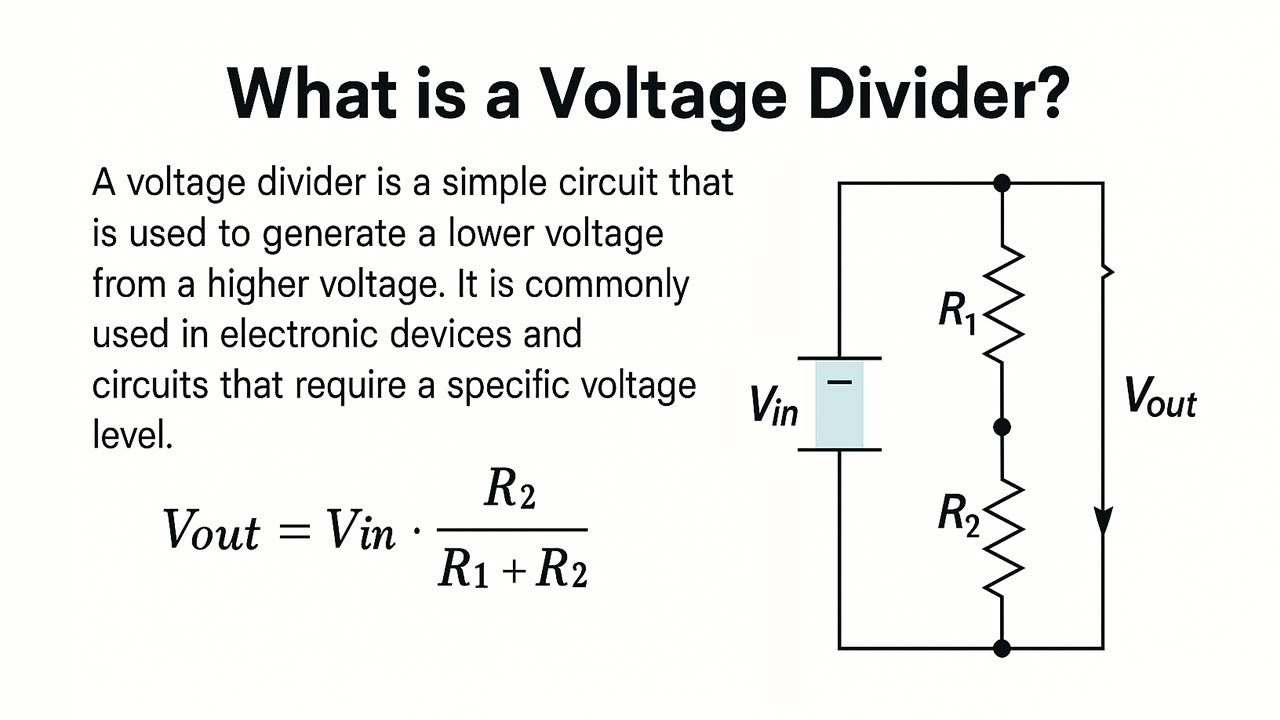
A voltage divider is a simple linear circuit that produces an output voltage (V_out) that is a fraction of its input voltage (V_in). It usually consists of two resistors connected in series. This fractional voltage can then be safely supplied to components like microcontrollers, sensors, and operational amplifiers that require specific voltage levels.
The Basic Principle of a Voltage Divider
At its core, a voltage divider works on Ohm’s Law and Kirchhoff’s Voltage Law (KVL). When two resistors are connected in series across a voltage source, the voltage drop across each resistor depends on its resistance value relative to the total resistance.
This relationship allows the voltage to be “divided” between them, hence the name.
Voltage Divider Formula Explained
The voltage across the second resistor R2R_2 R 2 in a basic divider is calculated as:
Vout=Vin⋅R2R1+R2V_{out} = V_{in} \cdot \frac{R_2}{R_1 + R_2} V o u t = V in ⋅ R 1 + R 2 R 2
Where:
- VinV_{in} V in = Input Voltage
- R1R_1 R 1 = Resistance of the first resistor
- R2R_2 R 2 = Resistance of the second resistor
- VoutV_{out} V o u t = Output Voltage
This formula assumes no significant current is drawn from the output. If a load is connected, it must be considered as part of the calculation.
Common Use Cases of Voltage Dividers
Sensor Interfacing
Many analog sensors output voltages that exceed microcontroller input thresholds. A voltage divider steps these signals down to safe levels.
Level Shifting Between Logic Devices
For interfacing 5V logic devices with 3.3V logic devices (or vice versa), voltage dividers provide a low-cost, passive solution for downward level shifting.
Analog to Digital Conversion Optimization
Voltage dividers can scale sensor outputs to the ideal input range for ADCs, improving resolution and accuracy in readings.
Limitations and Considerations
- Load Effect: Connecting a load alters the effective resistance, changing the output voltage. Always account for the load’s resistance.
- Power Dissipation: Resistors convert excess voltage to heat. Use appropriate wattage ratings.
- Precision: Voltage dividers are not suitable for applications requiring high precision unless resistors with tight tolerances are used.
- Dynamic Loads: If the load current changes significantly, the voltage divider may not perform reliably.
Real-World Example Calculation
Suppose you need to reduce 12V down to 5V using a voltage divider. Here’s how you do it:
Given:
- Vin=12VV_{in} = 12V V in = 12 V
- Vout=5VV_{out} = 5V V o u t = 5 V
Use the formula:
R2R1+R2=512\frac{R_2}{R_1 + R_2} = \frac{5}{12} R 1 + R 2 R 2 = 125
Let’s assume R2=10kΩR_2 = 10k\Omega R 2 = 10 k Ω . Solve for R1R_1 R 1 :
10kR1+10k=512⇒R1=14kΩ\frac{10k}{R_1 + 10k} = \frac{5}{12} \Rightarrow R_1 = 14k\Omega R 1 + 10k 10k = 125 ⇒ R 1 = 14 k Ω
Using 14kΩ for R1R_1 R 1 and 10kΩ for R2R_2 R 2 will give you approximately 5V output.
Top 5 Frequently Asked Questions
Final Thoughts
The voltage divider is deceptively simple but fundamentally powerful. Whether you’re building your first circuit or refining a complex embedded system, understanding how voltage division works helps ensure safe, accurate, and efficient voltage control. Just remember that while they’re excellent for low-current applications, voltage dividers are not a substitute for regulated power supplies when powering active components.
Leave A Comment