



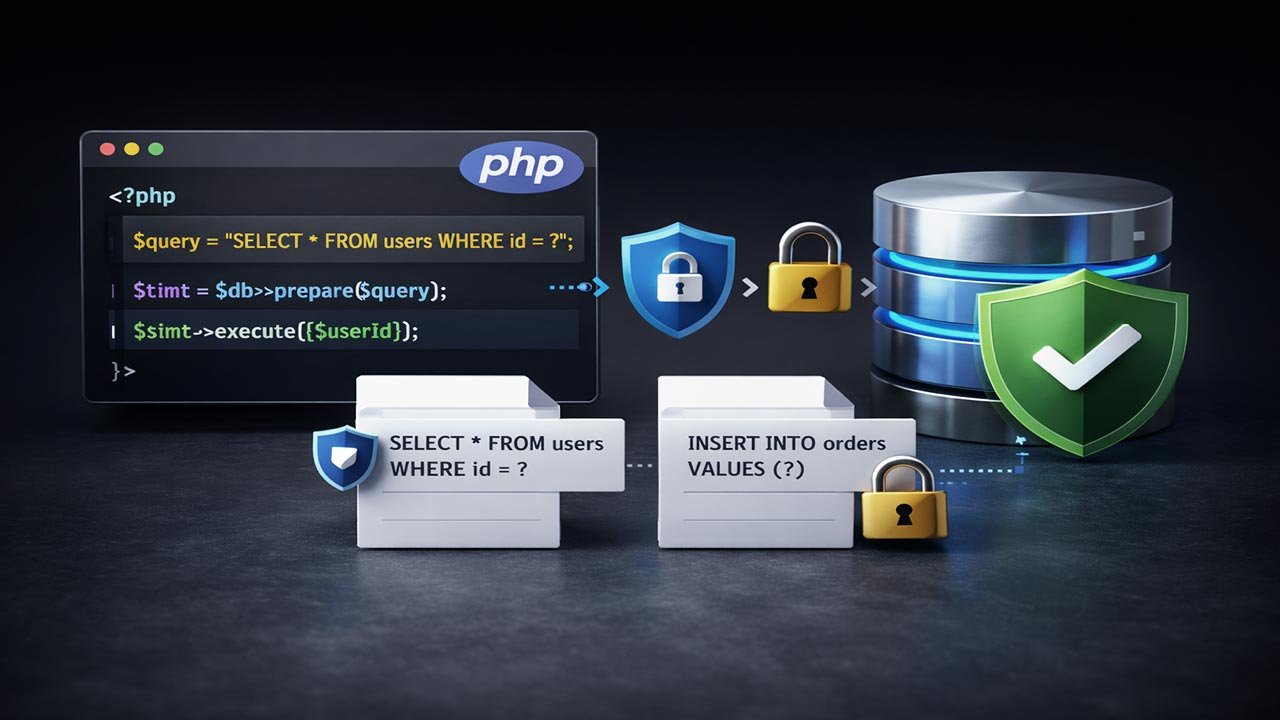
How to Use Prepared Statements in PHP for Secure and Scalable Applications
Prepared statements are one of the most important security and performance tools available to PHP developers working with databases. They protect applications from SQL injection attacks, improve query efficiency, and establish a professional standard for database interaction. This guide explains prepared statements in PHP from first principles through real-world implementation, ensuring you can confidently apply them in production environments.
Table of Contents
- What Are Prepared Statements
- Why Prepared Statements Matter in PHP
- PDO vs MySQLi Prepared Statements
- How to Use Prepared Statements with PDO
- How to Use Prepared Statements with MySQLi
- Best Practices for Prepared Statements
- Common Mistakes Developers Make
- Top 5 Frequently Asked Questions
- Final Thoughts
- Resources
What Are Prepared Statements
Prepared statements are precompiled SQL templates that separate query structure from user-supplied data. Instead of injecting variables directly into SQL strings, placeholders are used and populated later with bound values. The database engine parses the query once and safely inserts data without altering the SQL logic. This separation ensures that user input is treated strictly as data, not executable code. According to OWASP, SQL injection remains one of the top web application vulnerabilities, responsible for data breaches across industries. Prepared statements effectively neutralize this risk when implemented correctly.
Why Prepared Statements Matter in PHP
PHP powers over 75 percent of websites globally, making it a frequent target for database-based attacks. Prepared statements deliver three critical advantages. First, they provide robust protection against SQL injection. Because parameters are bound after the SQL is compiled, malicious input cannot change query behavior. Second, prepared statements improve performance in repeated queries. The database reuses the compiled execution plan, reducing overhead when running the same query multiple times with different values. Third, prepared statements enforce cleaner, more maintainable code. They encourage consistent query patterns, clearer intent, and easier debugging in complex systems.
PDO vs MySQLi Prepared Statements
PHP offers two primary interfaces for prepared statements: PDO and MySQLi. PDO, or PHP Data Objects, is database-agnostic. It supports multiple database drivers including MySQL, PostgreSQL, SQLite, and SQL Server. This makes PDO ideal for applications that may evolve or scale across database platforms. MySQLi, or MySQL Improved, is specific to MySQL databases. It offers both procedural and object-oriented APIs and provides slightly better performance in MySQL-only environments. From a technology management perspective, PDO is generally recommended for long-term scalability, while MySQLi may be preferred for tightly optimized MySQL deployments.
How to Use Prepared Statements with PDO
Using prepared statements with PDO follows a clear, repeatable workflow. First, establish a database connection using the PDO constructor. Enable exception-based error handling to catch failures early. Next, prepare the SQL statement using named or positional placeholders. Named placeholders improve readability in complex queries. Then, bind parameters using bindParam or bindValue. bindParam binds variables by reference, while bindValue binds the actual value at execution time. Finally, execute the statement and fetch results using fetch or fetchAll methods. This approach ensures consistent query behavior and simplifies debugging, especially in enterprise-grade applications.
How to Use Prepared Statements with MySQLi
Prepared statements in MySQLi are implemented using the prepare, bind_param, and execute methods. After establishing a MySQLi connection, the prepare method compiles the SQL query with placeholders. Parameters are then bound using bind_param, which requires explicit type definitions such as string, integer, double, or blob. Once executed, results can be retrieved using get_result or bound result variables. While slightly more verbose than PDO, MySQLi prepared statements are efficient and reliable for MySQL-specific workloads.
Best Practices for Prepared Statements
Always use prepared statements for any query that includes external input, even when data appears trusted. Avoid mixing prepared statements with dynamic SQL fragments. If query structure must change, validate inputs against strict allowlists. Reuse prepared statements inside loops for batch operations to maximize performance benefits. Enable strict error reporting and logging during development to identify binding and execution issues early. Finally, combine prepared statements with principle-of-least-privilege database accounts to further reduce risk exposure.
Common Mistakes Developers Make
One common error is assuming prepared statements sanitize everything. They only protect against SQL injection, not logical flaws or authorization issues. Another mistake is preparing statements but still concatenating variables into the SQL string, which defeats their purpose. Developers also frequently misuse bindParam when bindValue is more appropriate, leading to unexpected behavior in loops. Understanding these pitfalls is essential to using prepared statements effectively in real-world systems.
Top 5 Frequently Asked Questions
Final Thoughts
Prepared statements are not optional in modern PHP development. They are a foundational security control, a performance optimization, and a hallmark of professional engineering discipline. By adopting prepared statements consistently, developers reduce risk, improve maintainability, and future-proof their applications against evolving threats. In technology management terms, prepared statements represent a low-cost, high-impact investment with immediate and long-term returns.






Leave A Comment