


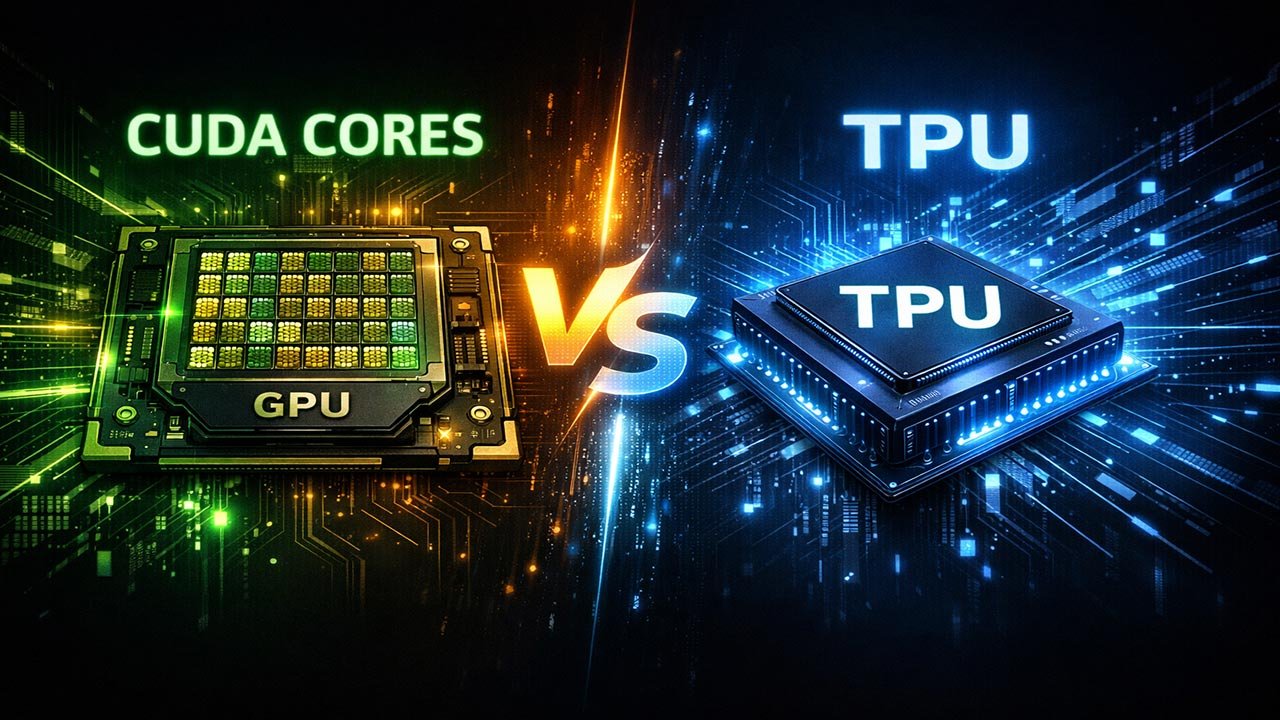
CUDA Cores vs TPU Compute Units: Understanding the Real Differences in AI Acceleration
Artificial intelligence workloads live and die by compute efficiency. As deep learning models grow in size and complexity, the choice of processing architecture has become a strategic decision rather than a technical afterthought. Two dominant paradigms define today’s AI acceleration landscape: CUDA cores found in NVIDIA GPUs and TPU compute units developed by Google. While both aim to accelerate machine learning, they are fundamentally different in design philosophy, programmability, and performance trade-offs.
Table of Contents
- What Are CUDA Cores?
- What Are TPU Compute Units?
- Architectural Differences That Matter
- Performance and Efficiency Comparison
- Software Ecosystem and Developer Experience
- Best Use Cases for CUDA vs TPUs
- Cost and Scalability Considerations
- Top 5 Frequently Asked Questions
- Final Thoughts
- Resources
What Are CUDA Cores?
CUDA cores are parallel processing units embedded inside NVIDIA GPUs. Each CUDA core is optimized for executing simple arithmetic operations, particularly floating-point math, across thousands of threads simultaneously. This massive parallelism makes GPUs exceptionally effective for workloads that can be decomposed into independent operations, such as matrix multiplication and vectorized computation. In AI workloads, CUDA cores are orchestrated through NVIDIA’s CUDA programming model, which allows developers to write highly optimized kernels for deep learning operations. Modern GPUs combine CUDA cores with specialized accelerators such as Tensor Cores, enabling mixed-precision computation that dramatically boosts training and inference throughput. The defining advantage of CUDA cores is flexibility. They can handle graphics rendering, scientific simulation, cryptography, and machine learning within the same hardware framework.
What Are TPU Compute Units?
TPU compute units are purpose-built accelerators designed exclusively for tensor operations. Unlike CUDA cores, which are general-purpose parallel processors, TPU units are optimized around systolic arrays—hardware pipelines that move data rhythmically through matrix multiplication circuits. Each TPU compute unit is engineered to maximize throughput per watt for dense linear algebra. The architecture assumes predictable workloads, minimal branching, and high arithmetic intensity. As a result, TPUs achieve extraordinary efficiency for neural network training and inference when models fit their constraints. TPUs are tightly integrated into Google’s cloud ecosystem and are primarily accessed through high-level frameworks rather than low-level hardware programming.
Architectural Differences That Matter
The core architectural difference between CUDA cores and TPU compute units lies in control versus specialization. CUDA cores rely on SIMT (Single Instruction, Multiple Threads) execution. This design supports complex control flow, branching, and heterogeneous workloads but incurs overhead when executing highly repetitive tensor operations. TPUs eliminate most control logic in favor of fixed-function matrix pipelines. This reduces instruction overhead and maximizes utilization, but it also limits flexibility. Any workload that deviates from dense tensor math sees diminishing returns on TPUs. From an innovation management perspective, CUDA represents architectural optionality, while TPUs represent architectural commitment.
Performance and Efficiency Comparison
Raw performance comparisons between CUDA cores and TPU compute units are misleading without context. In controlled benchmarks, TPUs often outperform GPUs in throughput per watt for large-scale training, particularly for transformer models and convolutional networks. However, GPUs maintain an advantage in latency-sensitive inference, mixed workloads, and research experimentation. CUDA-based systems also scale more gracefully across diverse model architectures, including sparse and custom layers. Efficiency metrics consistently show TPUs delivering superior FLOPS-per-watt, while GPUs dominate in FLOPS-per-dollar across varied workloads due to broader utilization.
Software Ecosystem and Developer Experience
CUDA benefits from a mature, deeply optimized ecosystem that includes libraries such as cuDNN, cuBLAS, and TensorRT. Developers have fine-grained control over memory, kernel fusion, and execution scheduling, which is invaluable for cutting-edge research. TPUs prioritize abstraction. Developers interact with them primarily through high-level APIs, with the compiler handling most optimization decisions. This reduces development friction but limits low-level tuning. In practical terms, CUDA empowers innovation at the cost of complexity, while TPUs prioritize operational simplicity over experimentation.
Best Use Cases for CUDA vs TPUs
CUDA cores excel in environments that demand versatility. Research labs, startups iterating on novel architectures, and production systems with mixed workloads benefit from GPU-based acceleration. TPU compute units are ideal for large-scale, stable workloads where models are well understood and training pipelines are standardized. Enterprises running massive training jobs or high-volume inference pipelines often see superior cost-efficiency with TPUs. Choosing between the two is less about raw speed and more about organizational maturity and workload predictability.
Cost and Scalability Considerations
From a cost perspective, GPUs offer greater resale value, broader vendor competition, and deployment flexibility across on-premise and cloud environments. TPUs, while efficient, lock organizations into a single cloud provider and execution model. Scalability favors TPUs for homogeneous workloads and GPUs for heterogeneous scaling. Strategic technology leaders often adopt a hybrid approach, using GPUs for experimentation and TPUs for production-scale training.
Top 5 Frequently Asked Questions
Final Thoughts
The debate between CUDA cores and TPU compute units is not about superiority but alignment. CUDA cores represent adaptability, ecosystem breadth, and research velocity. TPU compute units represent efficiency, scale, and operational focus. The most successful AI organizations understand that architectural decisions reflect business strategy as much as technical requirements. Choosing the right accelerator means understanding not just your model, but your roadmap.
Resources
- NVIDIA CUDA Programming Guide
- Google Cloud TPU Documentation
- Patterson et al., “Domain-Specific Architectures for Deep Learning”
- MLPerf Benchmark Results



Leave A Comment