


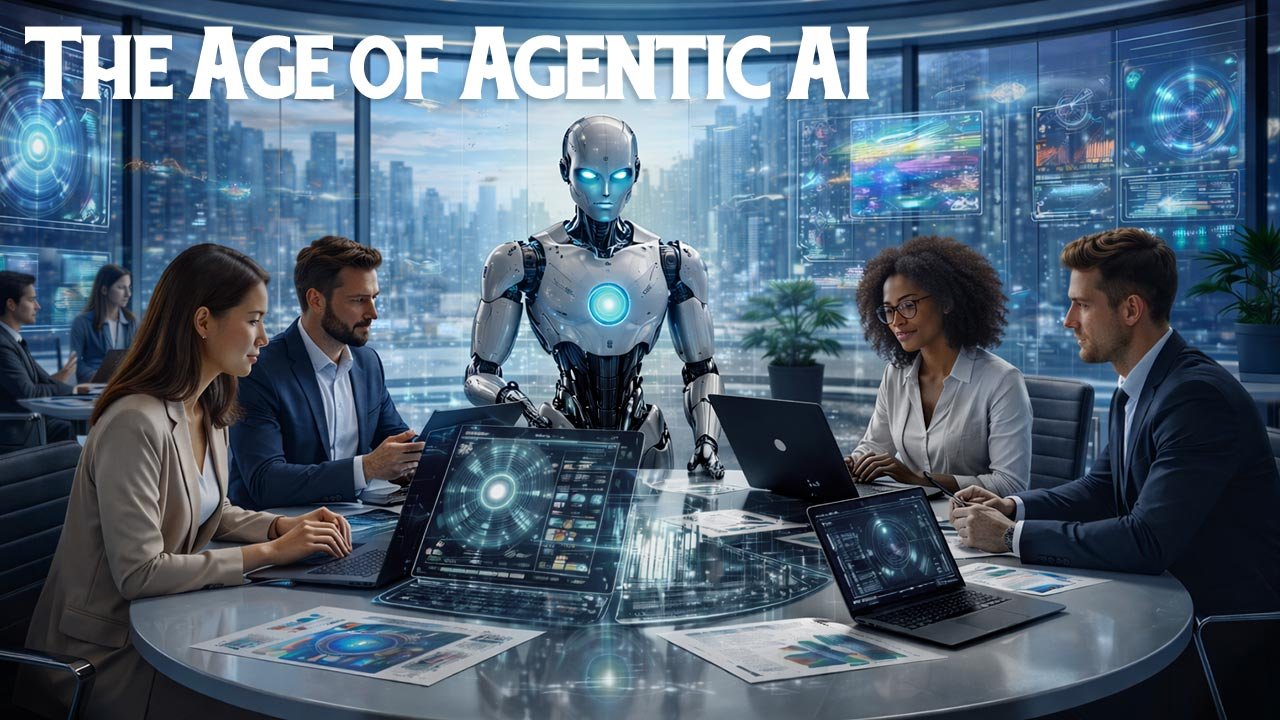
The Age of Agentic AI: Why Software Is No Longer a Tool but a Skill
AI is no longer something humans operate. It is something that operates on our behalf. This shift marks the beginning of the agentic era, where artificial intelligence evolves from passive software into active, autonomous skills that execute work independently. This transformation is already reshaping enterprise strategy, workforce design, and the economic foundations of knowledge work.
Table of Contents
- From Software Tools to AI Skills
- Why AI Agents Are the Next Dominant AI Form
- Executive and Industry Validation
- Platform Launches That Prove Commitment
- Enterprise Adoption at Scale
- Impact Across All Industries
- How AI Agents Reshape the Workforce
- The Rise of New Job Roles
- Why This Is Still the Beginning
- The Internet Parallel
- Top 5 Frequently Asked Questions
- Final Thoughts
- Resources
From Software Tools to AI Skills
For decades, computing followed a consistent mental model. Software was a tool. Humans provided direction, context, and execution logic. Even advanced automation required human orchestration. Agentic AI breaks that model. AI agents are autonomous actors that sit on top of tools, reason across objectives, and independently perform tasks. Instead of clicking buttons, users delegate intent. The AI decides how to achieve the goal, selects the appropriate tools, executes actions, and evaluates outcomes. This represents a foundational shift from “using software” to “deploying skills.”
Why AI Agents Are the Next Dominant AI Form
AI agents are widely viewed as the most advanced incarnation of artificial intelligence to date. Unlike traditional models that respond to prompts, agents plan, act, observe, and iterate. This belief is reinforced by the strategic direction of major technology platforms and the allocation of capital toward agent-first architectures. The industry consensus is increasingly clear: future AI systems will be agentic by default.
Executive and Industry Validation
Public endorsements and product roadmaps from major vendors indicate that agentic AI is not a fringe concept. Leaders across infrastructure and enterprise software are positioning agents as a foundation for the next wave of productivity and digital labor. What matters most is the pattern: the same “agentic” framing is showing up in platform strategy, developer tooling, and enterprise workflow design across the market.
Platform Launches That Prove Commitment
Agentic AI is already operational. Google introduced Gemini 2.0 as a model family “for the agentic era,” emphasizing multimodal capability and action-oriented applications. NVIDIA launched NeMo positioning it as an enterprise suite to build, monitor, and optimize agentic AI systems at scale. Salesforce released Agentforce and expanded the Agentforce platform through 2025, embedding agents directly into enterprise workflows and reporting rapid adoption in customer environments. These are not experiments. They are production platforms.
Enterprise Adoption at Scale
Momentum is not limited to a few early adopters. In an IBM and Morning Consult survey of more than 1,000 enterprise AI developers, 99% reported they are exploring or developing AI agents. That number signals a broad shift from “interest” to active build-and-test behavior. This level of participation suggests that many organizations are choosing to learn in public, iterate quickly, and develop agent readiness as a competitive capability.
Impact Across All Industries
Agentic AI is not limited to technology teams. Financial services use agents for compliance monitoring and research workflows. Healthcare organizations deploy agents for scheduling and documentation support. Legal teams rely on agents to accelerate review and analysis. Marketing, operations, procurement, and HR are also being redesigned around delegated work. On the automation horizon, some analyses suggest a large share of current work tasks could be automated with existing or near-term capabilities, with timelines depending on adoption pace, redesign of workflows, and regulatory constraints.
How AI Agents Reshape the Workforce
The workforce impact is double-edged. On the positive side, employees gain time for strategic thinking, creative problem-solving, and higher-value work. Quality can improve when repetitive execution is handled consistently and logged transparently. On the challenging side, companies may reduce headcount or operate with smaller teams. Demand shifts toward individuals who can design, supervise, and optimize agent workflows rather than execute tasks manually. This is not job elimination in a single moment. It is job redesign over time.
The Rise of New Job Roles
One of the most future-proof roles emerging is the manager of AI agents. This role focuses on orchestrating agent behavior, ensuring reliability, aligning outputs with business goals, and maintaining governance safeguards. In practice, it blends process design, quality assurance, risk management, and change leadership. Organizations that build this capability early create leverage: fewer people can reliably produce more outcomes, while keeping humans accountable for decisions.
Why This Is Still the Beginning
Despite adoption, today’s AI agents remain immature. Reliability, long-horizon planning, tool-use safety, and error recovery still require strong guardrails. The trajectory mirrors early mobile applications. Initial versions were limited, then iteration unlocked exponential capability. Agentic AI appears to be on a similar curve as platforms standardize evaluation, observability, and policy enforcement.
The Internet Parallel
The closest historical analogy to agentic AI is the early internet. At first it was narrow, awkward, and inconsistent. Over time it rewired communication, commerce, education, and entertainment. AI agents may be poised to do something comparable for knowledge work: turning intent into execution across systems, at scale.
Top 5 Frequently Asked Questions
Final Thoughts
Agentic AI represents a structural shift in how work is performed. Software is no longer a passive tool but an active skill that executes intent at scale. This transition will redefine productivity, workforce design, and competitive advantage. The winners won’t simply automate faster. They will redesign workflows so humans focus on judgment and direction, while agents handle execution with traceability and control.
Resources
- IBM + Morning Consult — Enterprise AI Development Survey (PDF)
- Google — “Introducing Gemini 2.0: our new AI model for the agentic era”
- NVIDIA — NeMo: Build, monitor, and optimize AI agents
- Salesforce — Rapid Agentforce adoption announcement (Dec 4, 2025)
- Brookings — Generative AI and the future of work (task disruption analysis)
- McKinsey perspective reported by Yahoo Finance — “70% of employees’ tasks could be automated” (Nov 27, 2023)



Leave A Comment