


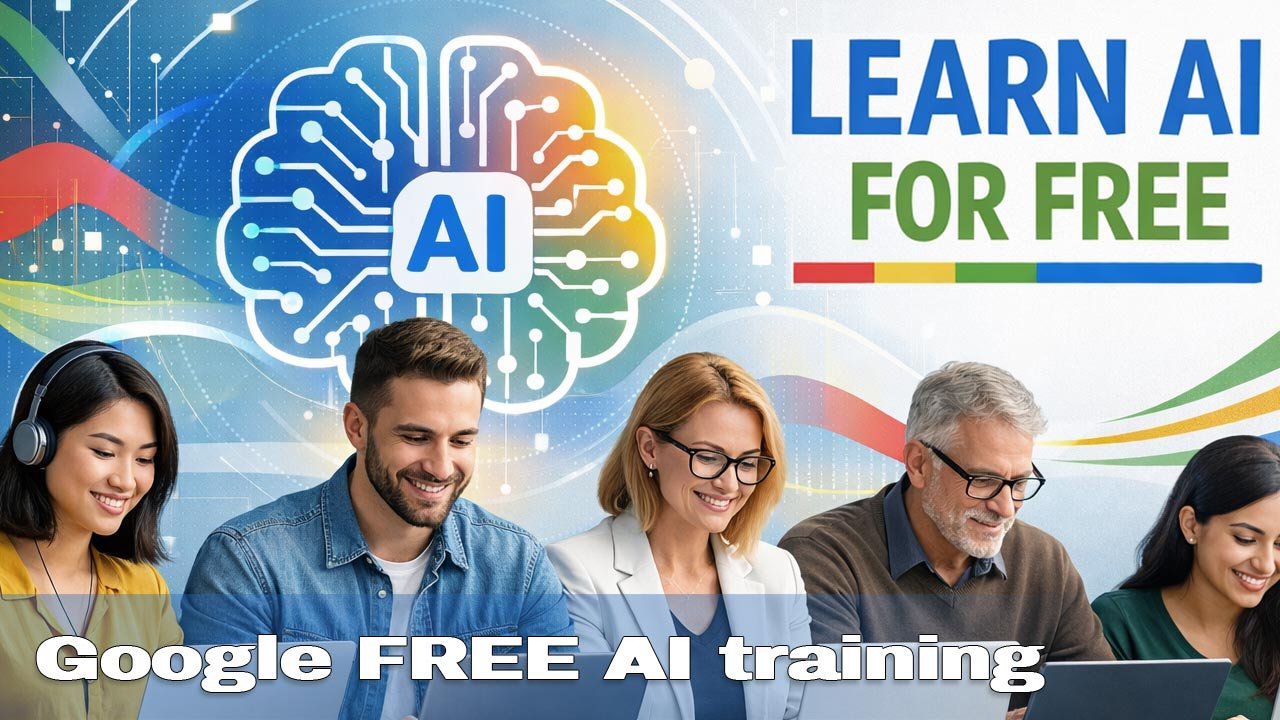
Google Now Offers AI Training for Free: What It Means for Professionals, Businesses, and the Future of Work
Google has quietly removed one of the biggest barriers to artificial intelligence education: cost. By offering free AI training through its learning platforms, Google is accelerating global AI literacy at a scale few organizations can match. This article explains what Google’s free AI training includes, who it is designed for, how it compares to paid alternatives, and why it represents a strategic shift in the future of work, innovation, and technology management.
Table of Contents
- Why AI Literacy Has Become Non-Negotiable
- What Google’s Free AI Training Actually Includes
- Who Benefits Most from Google’s Free AI Courses
- Closing the Global AI Skills Gap
- Implications for Businesses and Technology Leaders
- Free vs Paid AI Training: What You Gain and What You Don’t
- How Free AI Education Shapes the Future of Work
- Top 5 Frequently Asked Questions
- Final Thoughts
- Resources
Why AI Literacy Has Become Non-Negotiable
Artificial intelligence is no longer a niche capability reserved for data scientists and research labs. It is now embedded in search engines, marketing platforms, healthcare diagnostics, financial modeling, cybersecurity systems, and everyday productivity tools. According to McKinsey, AI adoption has more than doubled since 2017, with over 55 percent of organizations using AI in at least one business function.
This rapid adoption has exposed a critical weakness: the global AI skills gap. Organizations want to use AI, but employees often lack even foundational understanding. AI literacy today means knowing how models learn, where bias comes from, how prompts influence outputs, and when automation creates risk rather than value.
By offering AI training for free, Google is addressing this gap at its root. The move signals that AI understanding is becoming a baseline skill, much like digital literacy or basic data analysis.
What Google’s Free AI Training Actually Includes
Google’s free AI training is primarily delivered through Google Skillshop and Google’s learning initiatives under its AI and cloud education programs. These courses are designed to be accessible, modular, and practical rather than deeply academic.
Key areas covered include:
- Introduction to artificial intelligence and machine learning
- Generative AI fundamentals, including large language models
- Responsible AI and ethical considerations
- Prompting techniques for generative AI tools
- Applied AI use cases in business, marketing, and productivity
The content is structured for self-paced learning, typically requiring no prior technical background. While advanced engineering topics such as model architecture or custom training pipelines remain part of paid certifications, the free courses provide strong conceptual grounding.
From an innovation management perspective, this lowers experimentation friction. Teams can learn just enough AI to identify real opportunities before investing in deeper expertise.
Who Benefits Most from Google’s Free AI Courses
The decision to offer AI training at no cost broadens access far beyond traditional technical audiences.
Students and early-career professionals gain exposure to AI concepts that increase employability. Entry-level roles increasingly expect familiarity with AI-assisted workflows.
Non-technical professionals such as marketers, product managers, HR leaders, and operations managers can finally understand how AI fits into their decision-making processes without learning to code.
Small business owners and entrepreneurs benefit from learning how AI can automate customer service, content creation, analytics, and forecasting without hiring expensive consultants.
Public sector and nonprofit organizations gain access to AI education that can improve service delivery while remaining mindful of ethics and accountability.
This democratization of AI knowledge aligns with Google’s long-term ecosystem strategy: a workforce that understands AI is more likely to adopt AI-powered tools.
Closing the Global AI Skills Gap
The World Economic Forum estimates that 44 percent of workers’ skills will be disrupted by AI and automation by 2027. However, only a fraction of the global workforce currently receives structured AI training.
Free AI education changes the economics of reskilling. Instead of relying solely on corporate training budgets or elite universities, individuals can proactively upskill at scale.
From a technology management standpoint, this accelerates diffusion of innovation. As more people understand AI capabilities and limitations, adoption becomes more strategic rather than experimental or fear-driven.
Google’s approach also reinforces a critical idea: AI fluency does not require everyone to become a machine learning engineer. Most value comes from informed application, not model development.
Implications for Businesses and Technology Leaders
For organizations, Google’s free AI training has both opportunity and risk.
On the opportunity side, companies can encourage employees to complete foundational AI courses at zero cost. This creates a shared language around AI, enabling better collaboration between technical and non-technical teams.
It also supports change management. One of the biggest barriers to AI adoption is employee resistance driven by fear or misunderstanding. Education reduces anxiety and builds trust.
On the risk side, leaders must recognize that free training alone does not equal readiness. Without governance, ethics frameworks, and data strategy, AI experimentation can lead to compliance issues, bias, or reputational damage.
Effective technology management requires pairing education with clear policies, pilot programs, and oversight structures.
Free vs Paid AI Training: What You Gain and What You Don’t
Free AI training provides breadth, not depth. It is ideal for awareness, orientation, and basic application. Learners gain conceptual clarity, vocabulary, and confidence.
However, paid certifications and advanced programs still offer:
- Hands-on labs with real datasets
- Deep technical specialization
- Industry-recognized credentials
- Instructor-led guidance and feedback
For innovation leaders, the optimal strategy is layered learning. Use free courses to build baseline literacy across the organization, then selectively invest in advanced training for high-impact roles.
This blended approach maximizes return on learning investment while minimizing unnecessary spend.
How Free AI Education Shapes the Future of Work
AI is reshaping work faster than formal education systems can adapt. Free, on-demand training fills this gap by allowing continuous, just-in-time learning.
As AI tools become embedded in everyday software, workers who understand how to collaborate with AI will outperform those who resist it. Roles will shift from task execution to judgment, oversight, and creative problem-solving.
Google’s free AI training signals a future where AI competence is expected across functions, not confined to IT departments. This shift supports more agile organizations capable of rapid experimentation and innovation.
From a societal perspective, accessible AI education helps reduce inequality by preventing advanced technologies from being controlled by a small technical elite.
Top 5 Frequently Asked Questions
Final Thoughts
Google offering AI training for free is more than a generous educational initiative. It is a strategic move that accelerates AI adoption, shapes workforce expectations, and strengthens Google’s role at the center of the AI ecosystem.
For individuals, it removes excuses and barriers to learning one of the most important technologies of our time. For organizations, it offers a scalable way to build AI readiness without immediate financial investment. For society, it represents a step toward more inclusive technological progress.
The most important takeaway is simple: AI literacy is no longer optional. With free, high-quality training now available, the responsibility to learn shifts from institutions to individuals and leaders willing to act.





Leave A Comment