


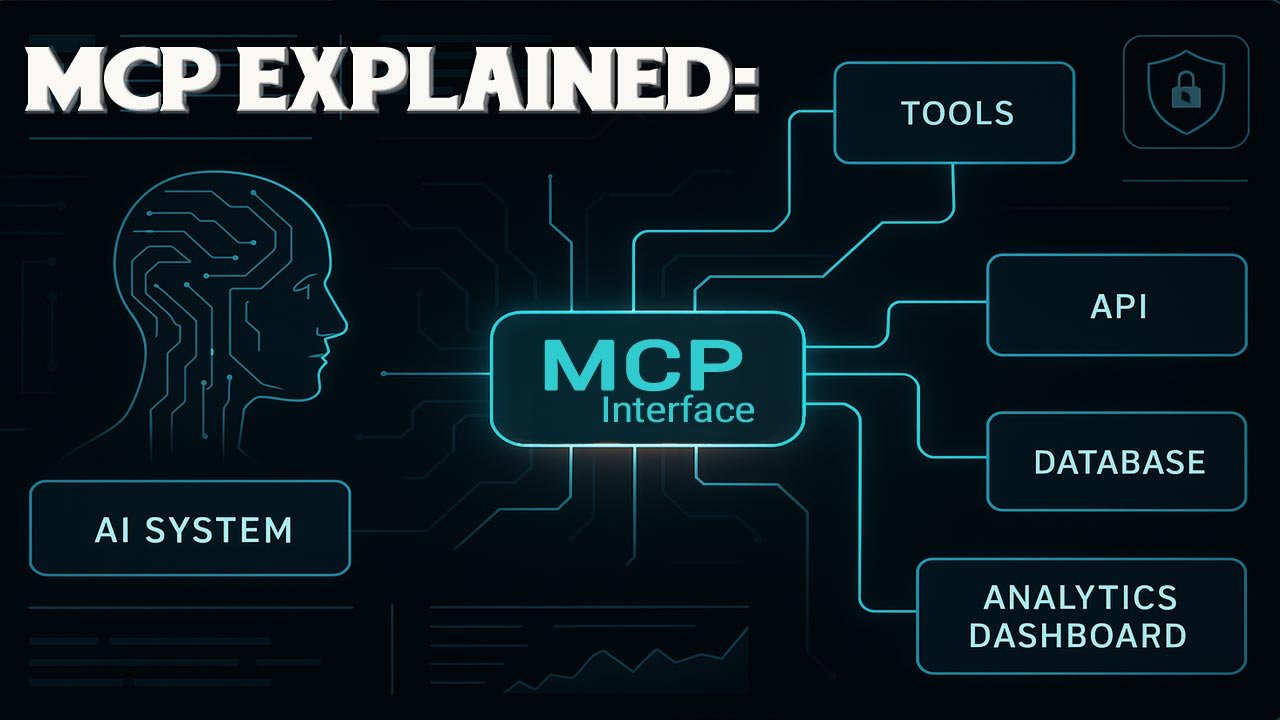
MCP Explained: How Model Context Protocol Lets AI Use Real Tools in a Safe and Structured Way
An exploration of how MCP introduces a universal, secure, and standardized layer that allows AI models to interact with tools, data sources, and operational systems while preserving safety, oversight, and predictable behavior.
Table of Contents
- Introduction: Why MCP Matters Now
- What Is the Model Context Protocol?
- How MCP Works: Core Architecture
- Key Benefits of MCP
- Enterprise and Industry Impacts
- Risks, Limitations, and Safety Considerations
- The Future of AI Tool-Use with MCP
- Top 5 Frequently Asked Questions
- Final Thoughts
- Resources
Introduction: Why MCP Matters Now
The rapid acceleration of AI capabilities has introduced a new challenge: models increasingly need to interact with real tools, data, and actions rather than operate as isolated text generators. These tools include databases, CRMs, payment systems, scheduling software, analytics dashboards, automation pipelines, and more. Historically, every AI-tool integration required custom engineering work, ad-hoc interfaces, and brittle safety guardrails. The industry lacked a universal standard.
MCP—Model Context Protocol—emerged to solve this problem by offering a unified, secure, interpretable framework for tool accessibility. Its purpose is simple yet transformative: give AI models the ability to use real tools safely and in a structured, auditable manner.
What Is the Model Context Protocol?
The Model Context Protocol (MCP) is an open, interoperable protocol that standardizes how AI models communicate with external tools, systems, and data sources. It defines how tools should expose capabilities, how AI can request actions, and how results should be returned in a predictable, context-aware format.
The protocol introduces shared expectations:
- models know what tools are available
- tools declare their capabilities explicitly
- interactions are permissioned and observable
- outputs follow structured formats conducive to verification
Unlike proprietary tool-calling methods, MCP is intentionally ecosystem-ready and designed for cross-model and cross-platform compatibility. This means an MCP-compatible service can be used by any compliant AI system, increasing interoperability and reducing vendor lock-in.
How MCP Works: Core Architecture
MCP relies on standardized components that organize and mediate interactions.
- The Client Layer
This layer represents the AI system (LLM, agent, or orchestration layer). It interprets the tool definitions served by MCP providers and determines when to use them. - The MCP Server (Tool Provider)
Servers describe tool capabilities using structured schemas. They expose functions such as querying a database, sending an HTTP request, triggering an automation, or executing a controlled action. - Context Exchange
The protocol exchanges formalized context objects, which supply relevant data, parameters, and environmental constraints that limit or inform tool behavior.
Execution Interface
Tools receive execution requests and return results in strongly typed responses. The model sees these results as trusted, verifiable outputs rather than unpredictable free-form text.
This design ensures that models are aware of their operational boundaries while organizations maintain oversight and safety guarantees.
Key Benefits of MCP
MCP delivers several strategic advantages across industries:
- Standardization Reduces Engineering Overhead
By defining a universal protocol, MCP eliminates the need for bespoke integration code for every AI model or platform. - Safety and Governance Built In
MCP allows organizations to define permissions, audit actions, and constrain tool behaviors. This reduces the risk of unauthorized or unsafe AI-initiated operations. - Cross-Model Compatibility
Because MCP is not tied to a single vendor, it can support various AI engines simultaneously—critical for enterprises adopting multi-model strategies. - Traceability and Auditability
Every tool request and response is structured, timestamped, and available for logging. This transparency supports regulatory compliance and internal governance. - Faster Innovation Cycles
Teams can expose new tools to AI systems simply by implementing MCP servers, dramatically reducing integration friction.
Enterprise and Industry Impacts
As modern organizations race to operationalize AI at scale, MCP becomes a central enabler.
Digital Transformation Acceleration
Enterprises historically moved slowly when connecting AI systems to sensitive internal infrastructure. MCP introduces safer pathways for automation and decision support.
Sector-Specific Applications
- Finance: audited tool use for transaction checks, fraud risk scoring, compliance workflows.
- Healthcare: secure access to patient records, scheduling tools, and clinical knowledge systems.
- Manufacturing: automated production diagnostics, maintenance data retrieval, and process optimization.
- Retail: AI-driven inventory actions, dynamic pricing, and customer operations.
In each domain, MCP reduces friction while strengthening oversight.
Vendor-Neutral Ecosystem Formation
When tools and models speak a common protocol, organizations can adopt a modular architecture—swapping models or integrating emerging services without extensive reengineering. This mirrors the role of TCP/IP or REST in the evolution of the web.
Risks, Limitations, and Safety Considerations
Despite its strengths, MCP requires thoughtful implementation.
Context Misalignment
If context objects are incomplete or poorly designed, AI decisions may be based on incorrect assumptions.
Over-Permissioning
As with any permissioned system, granting excessive tool capabilities can lead to unintended consequences. Least-privilege design remains essential.
Operational Complexity
Organizations must maintain MCP servers, monitor tool behavior, and ensure schemas remain synchronized with business logic.
Model Misinterpretation
Even with structured protocol definitions, AI systems may misinterpret tool affordances. Alignment testing and sandbox environments reduce this risk.
Regulatory Implications
As AI gains tool-use abilities, governance frameworks must evolve. MCP provides transparency but does not by itself define compliance standards.
The Future of AI Tool-Use with MCP
MCP is poised to become a dominant standard for structured AI interaction. Several trends will drive adoption:
Multi-Agent Architectures
Agents coordinating across systems need predictable interfaces—MCP offers that scaffolding.
Enterprise-Scale AI Automation
Future workflows will rely heavily on AI-driven operations, from document processing to customer service orchestration to operational decision-making. MCP provides the rails for these systems.
Interoperability Across Models
As organizations adopt mixtures of closed-source, open-source, and domain-specific foundational models, MCP becomes a universal translation layer.
Tooling Market Expansion
Expect a surge in MCP-compatible APIs, automation suites, and internal enterprise services.
Governance and Observability Ecosystems
New tooling will emerge that monitors, analyzes, and validates AI’s interactions with MCP-enabled systems—creating full observability stacks for AI operations.
Overall, MCP’s introduction represents a fundamental shift: AI is no longer limited to generating text—it can responsibly interact with the world.
Top 5 Frequently Asked Questions
Final Thoughts
The most important takeaway is that MCP creates a universal, safe, and highly governable method for empowering AI models to take meaningful actions in the real world. Instead of relying on brittle, model-specific integrations, MCP defines a durable architecture for tool usability. This is the foundational layer that will support enterprise automation, agent ecosystems, and the next generation of operational AI. MCP moves AI beyond text and into purposeful, auditable action—unlocking innovation while preserving oversight and safety.





Leave A Comment