


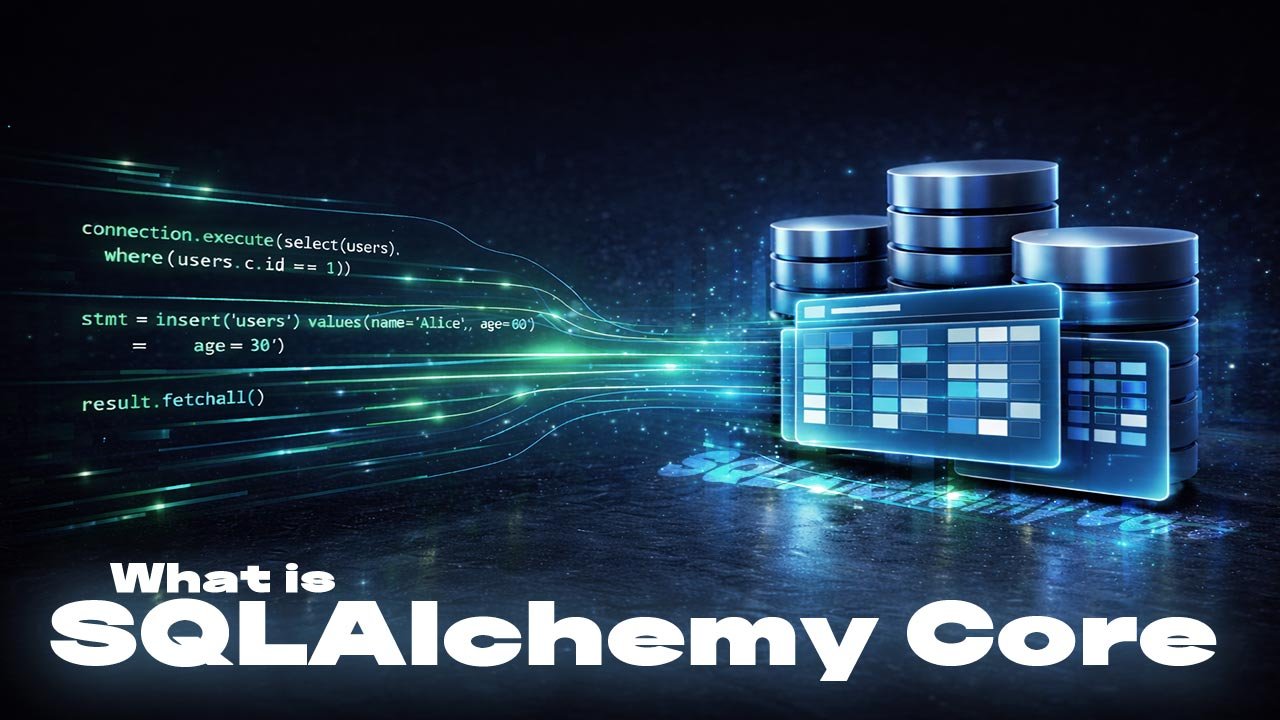
A Guide to Python’s Most Powerful SQL Toolkit, SQLAlchemy Core
A beginner-friendly, hands-on guide to SQLAlchemy Core that explains how to write efficient, database-agnostic SQL in Python without the complexity of ORMs, helping developers gain full control over queries, performance, and schema design.
Table of Contents
- What Is SQLAlchemy Core?
- SQLAlchemy Core vs ORM
- Why Use SQLAlchemy Core?
- Installation and Basic Setup
- Understanding Engines and Connections
- Defining Tables and Metadata
- CRUD Operations with SQLAlchemy Core
- Building Queries with Expressions
- Working with Transactions
- Performance and Best Practices
- Common Beginner Mistakes
- Top 5 Frequently Asked Questions
- Final Thoughts
- Resources
What Is SQLAlchemy Core?
SQLAlchemy Core is the foundational layer of the SQLAlchemy library that provides a Pythonic way to interact with relational databases using explicit SQL constructs. Unlike higher-level abstractions, Core focuses on SQL expression language, schema definition, and direct execution of statements. It is designed to be lightweight, flexible, and close to raw SQL while still offering safety, portability, and composability. At its core, SQLAlchemy Core acts as a database toolkit rather than a full data-mapping solution. It supports multiple database backends such as PostgreSQL, MySQL, SQLite, and Oracle, enabling developers to write database-agnostic code while retaining precise control over queries.
SQLAlchemy Core vs ORM
SQLAlchemy offers two primary interfaces: Core and ORM. The ORM maps database tables to Python classes and rows to objects. SQLAlchemy Core, on the other hand, works directly with tables, columns, and SQL expressions. Core is ideal when developers need predictable SQL output, fine-grained query optimization, or integration with legacy databases. The ORM excels in rapid application development where object manipulation is more intuitive than SQL composition. According to SQLAlchemy’s maintainers, both layers share the same engine and transaction system, making them interoperable. For beginners, learning Core first builds a solid understanding of SQL mechanics before introducing object-relational abstractions.
Why Use SQLAlchemy Core?
SQLAlchemy Core is widely adopted in data-intensive applications due to its explicitness and performance transparency. Companies handling large datasets often prefer Core to avoid ORM overhead and unpredictable query generation. Key advantages include database portability, protection against SQL injection, composable query building, and full access to SQL features like joins, subqueries, and window functions. A 2023 JetBrains Python Developers Survey reported that over 40 percent of backend developers using SQLAlchemy rely primarily on Core or hybrid approaches.
Installation and Basic Setup
SQLAlchemy Core is installed using pip. A compatible database driver is also required, such as psycopg2 for PostgreSQL or sqlite3 for SQLite. Once installed, the first step is importing the create_engine function, which establishes connectivity to the database. The engine acts as the central point of communication between the application and the database. The connection string defines the database dialect, driver, credentials, and host information, allowing SQLAlchemy to adapt behavior based on the backend.
Understanding Engines and Connections
The engine is responsible for managing connection pools and database dialects. It does not execute SQL directly but provides connections that do. A connection represents an active DBAPI connection and is used to execute SQL statements. SQLAlchemy encourages explicit connection handling, making resource usage predictable. This design supports scalability and concurrency, especially in high-throughput applications.
Defining Tables and Metadata
Tables in SQLAlchemy Core are defined using the Table class and associated with a MetaData object. Metadata acts as a registry that stores table definitions and schema information. Columns are defined with names, data types, and optional constraints such as primary keys, foreign keys, and indexes. SQLAlchemy provides rich type definitions that map to database-specific types while maintaining portability. This explicit schema definition enables automatic schema generation, validation, and reflection from existing databases.
CRUD Operations with SQLAlchemy Core
CRUD operations in SQLAlchemy Core are performed using SQL expression constructs such as insert, select, update, and delete. These constructs generate SQL statements dynamically and safely. Insert statements allow bulk inserts with dictionaries or lists of dictionaries. Select statements support filtering, sorting, grouping, and joins. Update and delete operations are explicit and require where clauses to prevent accidental full-table modifications. This explicit nature significantly reduces unintended data corruption, a common risk with implicit ORM updates.
Building Queries with Expressions
SQLAlchemy Core’s expression language is its most powerful feature. Queries are composed using Python operators that translate into SQL syntax. This approach allows dynamic query construction while preserving readability. Complex queries involving joins, subqueries, and aggregate functions can be built incrementally. Expressions are lazily evaluated, meaning SQL is only generated at execution time, allowing further modification until the final step.
Working with Transactions
Transactions in SQLAlchemy Core are managed explicitly through connection objects. A transaction ensures atomicity, consistency, isolation, and durability, collectively known as ACID properties. SQLAlchemy supports nested transactions and savepoints, enabling fine-grained rollback control. Explicit transaction handling is critical in financial systems, data pipelines, and any application requiring strong data integrity guarantees.
Performance and Best Practices
Optimized for performance when used correctly. Best practices include reusing engines, leveraging connection pooling, batching inserts, and avoiding unnecessary round trips to the database. Profiling tools such as SQLAlchemy’s echo mode and database execution plans help identify bottlenecks. According to PostgreSQL benchmarks published by several open-source contributors, Core-based queries often outperform ORM-generated SQL in complex analytical workloads.
Common Beginner Mistakes
Beginners often confuse SQLAlchemy Core with the ORM and attempt to use object-like patterns. Another frequent mistake is not closing connections properly, leading to connection pool exhaustion. Misunderstanding lazy execution can also cause confusion when debugging. Developers should remember that SQL is not sent to the database until execute is called on a connection.
Top 5 Frequently Asked Questions
Final Thoughts
SQLAlchemy Core empowers developers with precision, transparency, and performance control that few Python database libraries can match. By learning Core first, beginners build a strong mental model of SQL operations while benefiting from Pythonic abstractions and safety guarantees. The most important takeaway is that SQLAlchemy Core does not replace SQL knowledge but amplifies it, making developers more effective, confident, and scalable in database-driven systems.
Resources
- Official SQLAlchemy Core Documentation
- Real Python: SQLAlchemy Guide
- JetBrains Python Developers Survey





Leave A Comment