


Simple Audio Circuits at Home in Minutes for Beginners
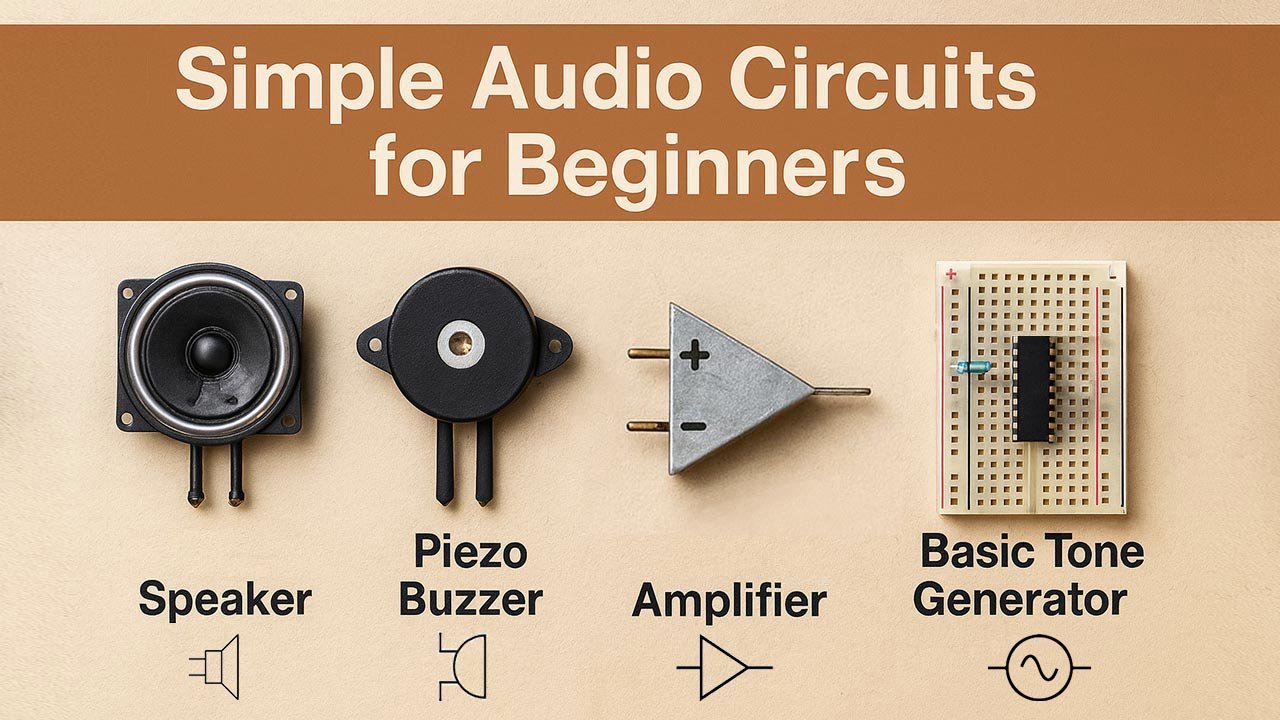
Today we’ll break down the fundamental building blocks of beginner-friendly audio electronics. You will learn how speakers work, why piezo buzzers behave differently from traditional drivers, how small amplifiers boost weak signals, and how simple tone-generation circuits create sound from almost any power source. Whether you are exploring DIY electronics, building your first hobby project, or enhancing your understanding of audio technology, this guide provides clear explanations with practical examples.
Table of Contents
- Introduction
- How Speakers Work
- Piezo Buzzers
- Understanding Audio Amplifiers
- Basic Tone Generation Circuits
- Top 5 Frequently Asked Questions
- Final Thoughts
- Resources
Introduction
Audio circuits are often the first hands-on experience electronics learners encounter. They are inexpensive, forgiving, and visually intuitive. More importantly, audio is a universal language, and hearing a tone, beep, or melody from a circuit creates an instant sense of accomplishment.
Four foundational elements make up most beginner audio experiments:
- Speakers – electromechanical devices that convert electricity into sound waves.
- Piezo buzzers – ceramic-based sounders ideal for simple alarms and tones.
- Amplifiers – electronic circuits that increase signal strength to drive speakers.
- Tone generators – circuits that create the electrical signals used to produce sound.
This article explains each component with clarity, minimal jargon, and industry-relevant detail.
How Speakers Work
Speakers are the most familiar audio output device. At the beginner level, you will usually work with small dynamic drivers, typically between 0.25 and 3 watts. Their job is simple: convert electrical current into physical motion.
Dynamic Drivers
Dynamic speakers rely on electromagnetism. When electrical current flows through a voice coil, it creates a temporary magnetic field. This field interacts with a permanent magnet attached to the speaker frame. As current alternates in the form of an audio signal, the coil moves forward and backward, pushing and pulling a diaphragm. This movement compresses air and produces sound.
Key components include:
- Voice coil – copper winding that moves with the audio signal.
- Magnet – creates a static magnetic field.
- Diaphragm or cone – moves air to create sound waves.
Beginners often start with:
- 8 ohm speakers commonly included in hobby kits.
- Power ratings around 0.5 to 1 watt.
- Diameters in the 2 to 4 inch range.
Small drivers are forgiving and match well with low-voltage circuits.
Impedance and Power Handling
Impedance, measured in ohms, matters because it limits how much current flows from the amplifier.
For example:
- 8 ohm speakers draw less current and are safer for small circuits.
- 4 ohm speakers draw more current and require stronger amplifiers.
Using a speaker with too low an impedance can overload your amplifier or microcontroller, leading to distortion, overheating, or permanent damage.
Piezo Buzzers
Piezo buzzers are widely used because they are cheap, lightweight, and extremely power efficient. They operate using the piezoelectric effect in which certain ceramic materials flex when voltage is applied.
A piezo element is essentially a small ceramic disc bonded to a thin metal plate. Applying alternating voltage causes the plate to vibrate, creating sound.
Active vs. Passive Piezo Modules
Understanding the difference between active and passive piezo buzzers is essential for beginners.
Passive Piezo Elements
- Usually appear as bare two-wire disks.
- Require an oscillating signal to produce sound.
- Work directly with 555 timers or microcontrollers.
- Can produce a wide range of frequencies depending on the drive signal.
Active Piezo Buzzers
- Contain an internal oscillator circuit.
- Produce a fixed tone, often between 2 and 4 kilohertz.
- Only need a DC voltage to operate.
- Ideal for alarms, beepers, and simple status indicators.
Why Piezo Elements Are So Efficient
Because piezo buzzers rely on ceramic flexing instead of moving a coil in a magnetic field, they consume very small amounts of current, often less than 15 milliamps even at high volume. This makes them well suited for:
- Battery-powered timers.
- Toys and educational kits.
- Household alarms.
- Embedded microcontroller projects where low power is critical.
Understanding Audio Amplifiers
Most beginner circuits produce very weak signals that are too small to drive a full speaker. An audio amplifier boosts that signal to a level strong enough to move a speaker cone with authority.
Gain, Inputs, and Signal Strength
Amplifiers focus on three core concepts:
- Gain, which describes how much the amplifier multiplies the input signal.
- Input sensitivity, which is the minimum signal level required to reach full output power.
- Output power, which is how much power the amplifier can deliver to the speaker.
Small hobby amplifiers often deliver between 0.5 and 3 watts, which is perfect for desktop speakers and experimental setups.
Beginner-Friendly Amplifier Types
LM386 Audio Amplifier
The LM386 is an iconic beginner audio amplifier integrated circuit.
- Operates from 5 to 12 volts.
- Provides a built in gain of about 20 that can be increased to around 200 with extra components.
- Drives 0.5 to 1 watt speakers easily.
- Requires very few external components for a basic circuit.
Because of its simplicity and reliability, the LM386 remains a favorite in DIY audio kits and teaching labs.
Class D Mini Amplifier Modules
Modern class D modules, such as the PAM8403 boards commonly found online, offer:
- Very high efficiency, often above 80 percent.
- Low heat output thanks to switching operation.
- Three watts or more per channel out of a tiny board.
- Friendly operation from USB style 5 volt supplies.
Due to their efficiency, these modules work extremely well in battery powered speaker projects and portable gadgets.
Basic Tone Generation Circuits
Audio is fundamentally varying electrical frequency. Tone generators act as the brain of simple sound circuits by creating those periodic waveforms.
Below are the most common beginner-friendly methods.
The 555 Timer Square Wave Oscillator
The 555 timer is one of the most versatile and widely used integrated circuits in electronics. In astable mode, it generates a continuous square wave.
Reasons it is ideal for beginners include:
- It is easy to wire on a breadboard.
- The output frequency is determined by only two resistors and a capacitor.
- It can directly drive many piezo buzzers.
- The tone frequency is easily adjustable from a few hertz to tens of kilohertz.
A typical beginner circuit uses resistors R1 and R2 plus timing capacitor C1 to set the oscillation rate, with the output taken from the 555 timer’s pin 3 and fed into a buzzer or amplifier.
Microcontroller Based Tone Generation
Boards such as Arduino, ESP32, and Raspberry Pi Pico can generate tones using built in pulse width modulation outputs.
Advantages of microcontroller based generators:
- You can program precise pitches and durations.
- You can create melodies and sound effects in software.
- No external oscillator is required for basic tones.
- They demonstrate how digital logic can control analog sound hardware.
Microcontrollers are one of the easiest ways to create multi tone or musical outputs with minimal external circuitry.
Single Transistor Oscillator Circuits
A single transistor combined with a few resistors and a capacitor can form a simple relaxation oscillator. This is one of the most fundamental ways to generate a tone without an integrated circuit.
Benefits of this approach include:
- Very low component count and cost.
- Excellent for understanding basic analog behavior such as biasing and feedback.
- Good pairing with passive piezo elements for beeps and simple tones.
Although less stable and flexible than microcontroller or 555 based designs, single transistor oscillators are excellent teaching tools.
Top 5 Frequently Asked Questions
Final Thoughts
The most important takeaway is that simple audio circuits form a practical gateway into both analog and digital electronics. By experimenting with speakers, piezo buzzers, amplifiers, and tone generators, you learn how electrical signals transform into sound and how small changes in components affect what you hear. These concepts scale directly into more advanced domains such as embedded audio, consumer electronics, and professional sound design. Starting with modest low voltage projects builds intuition, confidence, and a solid technical foundation that carries over into every area of innovation and technology management where audio plays a role.
Resources
- Texas Instruments, 555 Timer datasheet and application notes.
- Texas Instruments, LM386 Low Voltage Audio Power Amplifier datasheet.
- ON Semiconductor and similar vendors, piezoelectric sounder application guides.
- Microchip and other microcontroller vendors, application notes on PWM based audio generation.
- Adafruit Learning System, tutorials on mini audio amplifiers, piezo buzzers, and Arduino sound projects.
Leave A Comment