


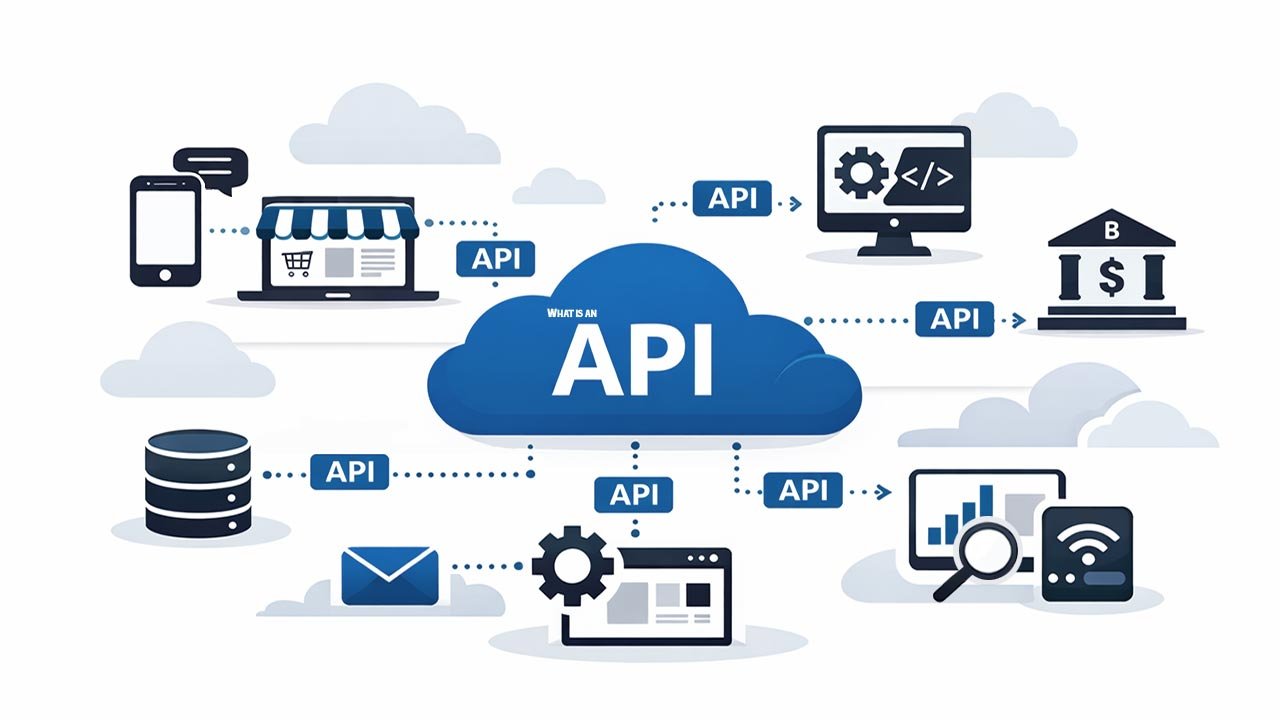
What is an API? A Practical Guide for Modern Digital Systems
A modern explanation of APIs, why they exist, how they work, and why they are the backbone of today’s software-driven economy, written for technical and non-technical readers alike.
Table of Contents
- What Is an API?
- Why APIs Exist
- How APIs Work
- Types of APIs
- Real-World API Examples
- API Security and Governance
- APIs and Digital Transformation
- Common API Misconceptions
- Top 5 Frequently Aske’d Questions
- Final Thoughts
- Resources
What Is an API?
An API, or Application Programming Interface, is a structured way for software systems to communicate with each other. It defines the rules, formats, and protocols that allow one application to request data or functionality from another without needing to understand its internal workings. At its core, an API is a contract. One system agrees to expose specific capabilities, such as retrieving data, processing a transaction, or triggering an action. Another system agrees to follow the defined rules when making requests. If both sides follow the contract, communication works reliably and at scale. APIs are not user interfaces. End users rarely see them, yet almost every digital interaction depends on them. When you check a weather app, book a flight, make an online payment, or log in using a social account, APIs are working behind the scenes to move data securely and efficiently.
Why APIs Exist
Before APIs became common, software systems were tightly coupled. Integrating two applications often required direct database access, custom code, or manual data transfers. These approaches were slow, fragile, and expensive to maintain. APIs exist to solve four critical problems. First, they enable modularity. Systems can evolve independently as long as the API contract remains stable. This reduces risk and accelerates innovation. Second, they enable reuse. A single API can serve multiple applications, platforms, and partners without duplicating logic. Third, they enable scalability. APIs allow organizations to expose services internally and externally in a controlled, standardized way. Fourth, they enable ecosystems. Entire business models now rely on APIs, from payment processing to cloud computing and artificial intelligence. According to industry research, organizations with mature API strategies deploy software up to 30 percent faster and experience significantly lower integration costs compared to those without standardized APIs.
How APIs Work
An API interaction follows a predictable flow. A client application sends a request to an API endpoint. The request specifies what action is needed, any required parameters, and authentication credentials. The API receives the request, validates it, and processes it using the underlying system or service. The API then returns a response, typically containing data, a confirmation message, or an error code. Most modern APIs use HTTP as the transport mechanism and exchange data using lightweight formats such as JSON. This makes APIs accessible across platforms, programming languages, and devices. The key to reliability is standardization. Clear documentation, consistent error handling, and version control ensure that APIs remain usable even as systems evolve.
Types of APIs
APIs can be categorized based on access level and architectural style. Public APIs are available to external developers and partners. They are commonly used to expand platform reach and create developer ecosystems. Private APIs are used internally within an organization. They support internal systems, microservices, and automation workflows. Partner APIs are shared with selected external parties under specific agreements. They are common in supply chains, finance, and logistics. From an architectural perspective, REST APIs dominate modern systems due to their simplicity and scalability. SOAP APIs are still used in regulated industries where strict standards are required. Event-driven and streaming APIs are gaining adoption in real-time systems such as financial trading and IoT platforms.
Real-World API Examples
APIs power nearly every digital service in use today. E-commerce platforms use APIs to connect storefronts, payment gateways, inventory systems, and shipping providers. Mobile applications rely on APIs to retrieve user data, sync content, and enable push notifications. Cloud platforms expose APIs that allow developers to provision servers, deploy applications, and monitor performance programmatically. Enterprise systems use APIs to integrate customer relationship management, enterprise resource planning, and analytics tools into cohesive digital workflows. In each case, APIs act as the glue that holds complex digital ecosystems together.
API Security and Governance
APIs expose valuable data and capabilities, making security a top priority. Authentication ensures that only authorized users and systems can access an API. Authorization defines what actions each user or system is allowed to perform. Encryption protects data in transit, preventing interception or tampering. Rate limiting prevents abuse by controlling how frequently an API can be called. Governance adds an organizational layer, defining standards for documentation, versioning, lifecycle management, and compliance. Without governance, APIs can become fragmented, insecure, and difficult to maintain. Industry data shows that API-related security incidents are often caused not by weak technology, but by poor visibility and inconsistent governance practices.
APIs and Digital Transformation
APIs are foundational to digital transformation initiatives. They enable legacy systems to participate in modern architectures without full replacement. They support agile development by allowing teams to work independently on different services. They enable platform strategies where organizations shift from selling products to delivering digital capabilities. In innovation management, APIs reduce the cost of experimentation. New ideas can be tested by composing existing services rather than building everything from scratch. This dramatically lowers time-to-market and increases the success rate of digital initiatives.
Common API Misconceptions
A common misconception is that APIs are only for developers. In reality, APIs are business assets that shape partnerships, revenue models, and competitive advantage. Another misconception is that APIs are inherently insecure. Properly designed APIs are often more secure than direct system integrations. Some believe APIs are only relevant to large technology companies. In practice, small and mid-sized organizations often benefit the most from API-driven efficiency and scalability.
Top 5 Frequently Asked Questions
Final Thoughts
APIs are no longer optional technical components. They are strategic enablers of speed, scalability, and innovation. Organizations that treat APIs as products rather than plumbing gain flexibility, unlock ecosystems, and adapt faster to market change. Understanding APIs is essential for anyone involved in digital strategy, product development, or technology-driven business transformation.
Resources
- MDN Web Docs – Web APIs Overview
- IBM API Guide
- Google Cloud API Design Guide
- Postman State of the API Report







Leave A Comment