


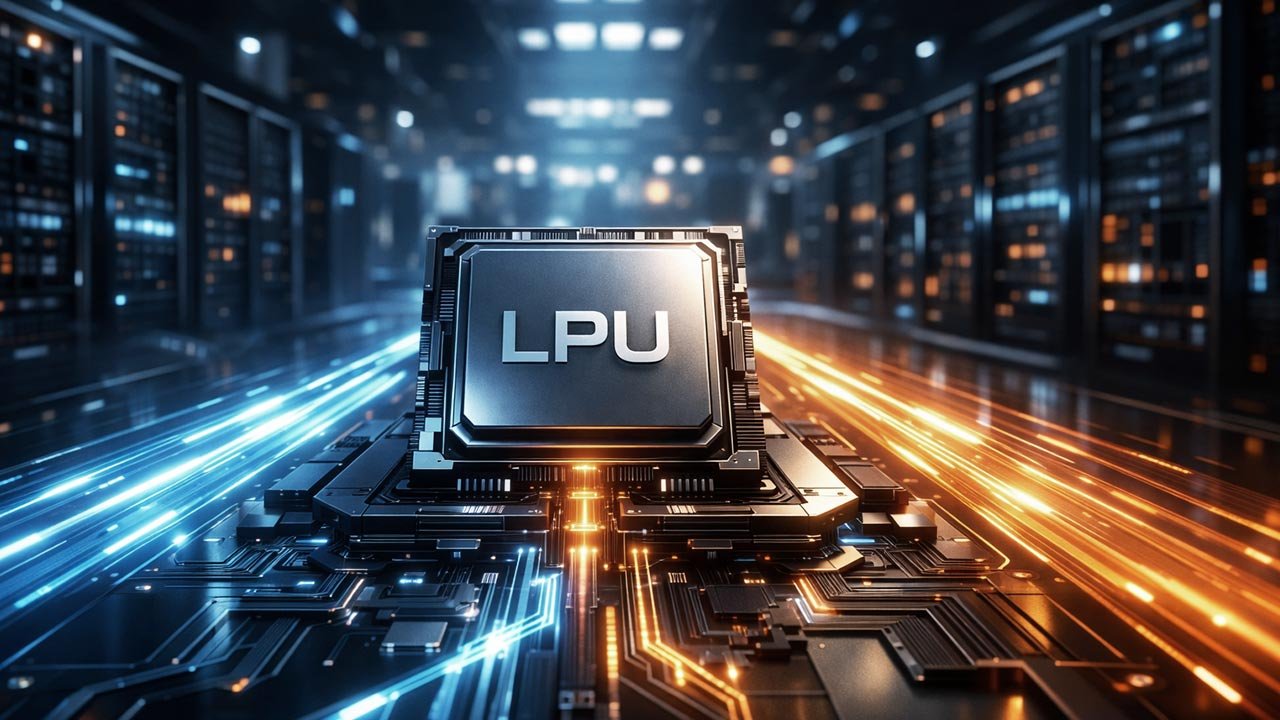
What Is the Groq LPU (Language Processing Unit)?
Groq’s Language Processing Unit (LPU) is a purpose-built AI processor designed specifically for ultra-fast, deterministic inference of large language models. Unlike GPUs and TPUs, which rely on parallel but non-deterministic execution, the Groq LPU executes AI workloads in a fully predictable, instruction-level pipeline.
The result is unprecedented performance for real-time language models, measured not just in throughput, but in latency measured in microseconds rather than milliseconds. The Groq LPU was created by Groq, a silicon company founded by former Google TPU engineers who set out to eliminate the inefficiencies they observed in general-purpose accelerators.
At its core, the Groq LPU rethinks how AI models should be executed when speed, consistency, and scalability matter more than raw parallelism.
Table of Contents
- Understanding the Language Processing Unit
- Why GPUs Struggle With AI Inference
- Groq LPU Architecture Explained
- Performance and Speed Benchmarks
- Real-World Use Cases
- Industry Impact and Competitive Position
- Top 5 Frequently Asked Questions
- Final Thoughts
- Resources
Understanding the Language Processing Unit
A Language Processing Unit is a specialized processor optimized for executing language model inference with deterministic timing. Determinism means that every operation occurs in a fixed sequence with known execution time, eliminating runtime variability.
Traditional accelerators schedule operations dynamically. The Groq LPU compiles entire AI models into a static execution plan, where every instruction is placed on a precisely timed hardware pipeline. This approach transforms AI execution from a probabilistic workload into a predictable compute process.
The LPU is particularly effective for transformer-based models, including large language models used in chatbots, code generation, and real-time reasoning systems.
Why GPUs Struggle With AI Inference
GPUs were designed for graphics rendering, not AI inference. While they excel at massive parallelism, they introduce several limitations when running large language models in production environments.
Key GPU challenges include memory bottlenecks, kernel launch overhead, unpredictable latency, and inefficient utilization for sequential token generation. Language models generate tokens one at a time, which means GPUs often sit idle between steps.
According to industry benchmarks, GPUs can process large batches efficiently, but performance drops sharply in low-batch or real-time scenarios. This is a critical limitation for applications like conversational AI, where response time directly impacts user experience.
The Groq LPU addresses this by executing each token deterministically, without scheduling delays or memory stalls.
Groq LPU Architecture Explained
The Groq LPU uses a software-defined hardware architecture. Instead of relying on caches, schedulers, and speculative execution, the compiler maps every operation directly onto the chip.
The architecture includes:
- A single instruction stream with no control divergence
- Massive on-chip SRAM to eliminate external memory latency
- Fixed-function execution units optimized for tensor operations
- Compile-time scheduling instead of runtime scheduling
This design removes unpredictability entirely. Every instruction executes exactly when expected, enabling consistent latency across requests regardless of load.
From an engineering perspective, this is closer to how telecom hardware or real-time systems are designed than traditional AI accelerators.
Performance and Speed Benchmarks
Groq has demonstrated industry-leading inference performance on large language models. Public benchmarks show throughput exceeding 500 tokens per second per chip on models with tens of billions of parameters.
More importantly, latency remains stable even under heavy load. While GPUs often exhibit tail latency spikes, the Groq LPU maintains predictable response times measured in microseconds per token.
Independent evaluations have shown that a single Groq system can outperform multi-GPU setups for real-time inference, while consuming less power per token generated.
This combination of speed, efficiency, and predictability is what differentiates the LPU from existing accelerators.
Real-World Use Cases
The Groq LPU is optimized for scenarios where low latency and consistent performance are mission-critical.
Common use cases include:
- Conversational AI and chatbots
- Real-time code completion
- Voice assistants and speech-to-text systems
- Autonomous agents and decision systems
- High-frequency AI APIs
These applications benefit from deterministic execution because they must respond instantly, even during traffic spikes.
Groq’s cloud offering allows developers to deploy models without managing hardware, making LPUs accessible without infrastructure expertise.
Industry Impact and Competitive Position
The Groq LPU challenges the assumption that GPUs are the default solution for AI workloads. By focusing exclusively on inference, Groq has carved out a distinct category of AI hardware.
While GPUs remain dominant for training, inference represents the majority of AI compute in production. As AI adoption scales, inference efficiency becomes a critical cost and performance factor.
Industry analysts increasingly view LPUs as a complementary architecture rather than a replacement. Inference-first accelerators may define the next phase of AI infrastructure, especially as real-time applications continue to grow.
Top 5 Frequently Asked Questions
Final Thoughts
The Groq LPU represents a fundamental shift in how AI inference is executed. By rejecting general-purpose design and embracing deterministic, software-defined hardware, Groq has unlocked levels of speed and predictability that GPUs struggle to match.
As AI systems move from experimentation to real-time deployment, the need for consistent, low-latency inference will only increase. The LPU model demonstrates that specialization, not brute force parallelism, may define the future of AI infrastructure.
For organizations building latency-sensitive AI products, the Groq LPU is not just an alternative — it is a glimpse into the next generation of AI compute.
Resources
- Groq Official Documentation
- AI Inference Hardware Analysis – IEEE Spectrum
- Transformer Inference Optimization – Stanford AI Lab






Leave A Comment