


What Is Product Benchmarking?
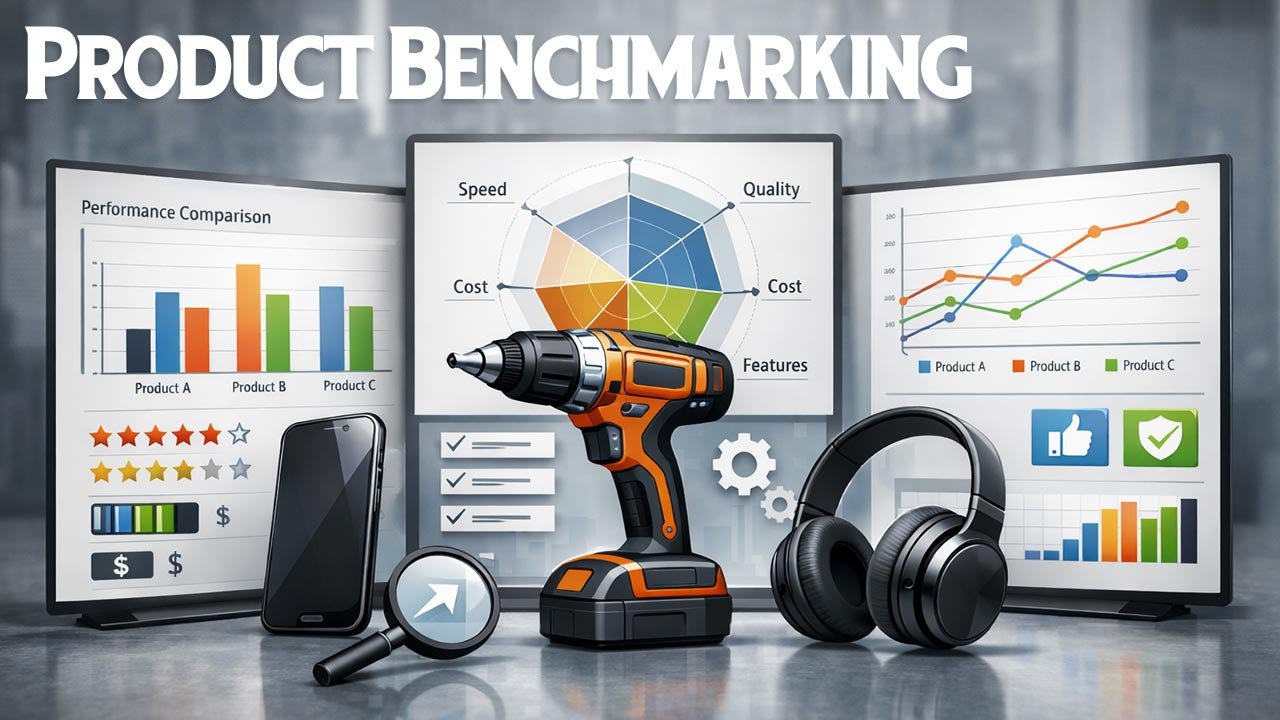
Product benchmarking is the structured process of comparing a product’s features, performance, cost, quality, and user experience against competitors or industry leaders to identify gaps, opportunities, and best practices that drive better decision-making and innovation. Product benchmarking helps organizations understand how their products truly perform in the market. By systematically comparing internal offerings with external standards, companies can improve competitiveness, reduce risk, and accelerate innovation.
Table of Contents
- Definition
- Types of Product Benchmarking
- The Product Benchmarking Process
- Key Metrics Used
- Benefits of Product Benchmarking
- Common Challenges and Risks
- Innovation Management
- Digital Tools and Technologies for Benchmarking
- Real-World Use Cases
- Top 5 Frequently Asked Questions
- Final Thoughts
- Resources
Definition
Product benchmarking is a competitive and analytical practice where a company evaluates its product against comparable products in the market or against internal reference products. The goal is not imitation but insight. Benchmarking reveals how a product performs across dimensions such as functionality, usability, reliability, cost efficiency, sustainability, and customer value. From an innovation and technology management perspective, benchmarking is a learning mechanism. It transforms external market signals into actionable knowledge that informs product strategy, R&D priorities, and lifecycle decisions.
Types of Product Benchmarking
Competitive benchmarking focuses on direct competitors offering similar products to the same target market. This is the most common form and supports positioning and differentiation decisions.
Functional benchmarking compares specific functions or components of a product against best-in-class solutions, even if they come from different industries. For example, a mobility company benchmarking battery management systems used in consumer electronics.
Internal benchmarking compares products, versions, or teams within the same organization. This is common in large enterprises with multiple product lines or regional variants.
Strategic benchmarking evaluates broader product strategies, such as pricing models, platform ecosystems, or modular architectures, rather than individual features.
The Product Benchmarking Process
Effective product benchmarking follows a disciplined and repeatable process. The first step is scope definition. Teams must clearly define which product, market segment, and performance dimensions are being benchmarked. Poorly defined scope leads to misleading conclusions. Next is benchmark selection. This involves identifying competitors, market leaders, or internal reference products that represent meaningful comparison points. The third step is data collection. Data may come from teardown analyses, product testing, customer reviews, patents, regulatory filings, pricing databases, and user experience evaluations. Then comes analysis and normalization. Raw data is adjusted to ensure fair comparison, accounting for differences in market context, scale, or customer expectations. The final step is insight translation. Findings are converted into product requirements, design trade-offs, cost targets, or roadmap adjustments.
Key Metrics Used
Product benchmarking relies on both quantitative and qualitative metrics. Quantitative metrics include performance benchmarks such as speed, efficiency, durability, defect rates, cost of goods sold, and time-to-market. In digital products, this may include latency, uptime, or feature adoption rates. Qualitative metrics focus on perceived value. These include usability, aesthetic design, brand perception, customer satisfaction, and ease of integration. In innovation-driven organizations, learning metrics are also important. These track how quickly insights from benchmarking translate into validated design improvements or reduced development risk.
Benefits of Product Benchmarking
Product benchmarking improves competitive awareness. It provides factual grounding for understanding why customers choose one product over another. It supports better investment decisions by revealing where incremental improvements create value and where differentiation is unnecessary. Benchmarking reduces innovation uncertainty. By learning from proven solutions, teams avoid reinventing the wheel while still focusing creativity on areas that matter most. It also strengthens cross-functional alignment. Shared benchmarks create a common language between engineering, product management, marketing, and leadership.
Common Challenges and Risks
One major risk is benchmarking blindness, where teams focus only on current competitors and miss disruptive innovations outside their category. Another challenge is data quality. Incomplete or biased data leads to incorrect conclusions and poor strategic decisions. There is also the risk of over-optimization. Excessive focus on matching competitors can result in feature parity rather than meaningful differentiation. Effective organizations treat benchmarking as an input to strategy, not a substitute for vision.
Innovation Management
In innovation and technology management, product benchmarking plays a dual role. It is both a defensive tool and an offensive one. Defensively, it ensures products meet baseline market expectations and regulatory or technical standards. Offensively, it reveals white spaces where unmet needs or inefficiencies exist. Many breakthrough innovations emerge from recognizing what competitors are not optimizing. High-performing organizations integrate benchmarking into continuous discovery cycles rather than treating it as a one-time activity.
Digital Tools and Technologies for Benchmarking
Modern product benchmarking is increasingly data-driven. Product analytics platforms, AI-powered market intelligence tools, and automated web scraping solutions accelerate insight generation. Digital twins and simulation tools allow teams to benchmark performance virtually before physical prototypes exist. In software products, telemetry and feature usage data provide real-time benchmarking signals. The integration of benchmarking tools into product lifecycle management systems ensures insights are preserved and reused over time.
Real-World Use Cases
In consumer electronics, benchmarking informs decisions about processor selection, battery life, and materials. In SaaS products, benchmarking compares onboarding flows, pricing tiers, and feature depth. In industrial manufacturing, product benchmarking guides cost reduction, reliability improvements, and compliance strategies. Across industries, benchmarking acts as a strategic compass rather than a tactical checklist.
Top 5 Frequently Asked Questions
Final Thoughts
Product benchmarking is not about copying competitors. It is about learning faster than the market. When applied thoughtfully, it strengthens product strategy, sharpens innovation focus, and reduces uncertainty in complex technology environments. The most successful organizations use benchmarking as a foundation for informed creativity, not as a ceiling on ambition.
Resources
- Harvard Business Review – Benchmarking and Competitive Strategy
- ISO 9001 Quality Management Principles
- Product Management Institute Research Publications
- OECD Innovation Strategy Reports








Leave A Comment